How to attract rose-breasted grosbeaks to your yard
Rose-breasted Grosbeaks respond to four things: the right food, the right plants, water and safe nesting cover. Here is what each means for this particular bird, drawn from its range across 38 states and provinces.
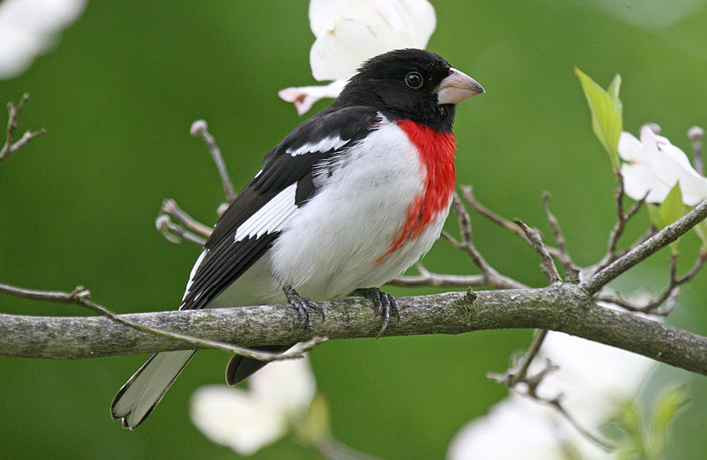
First: is it in your area, and when?
You can only attract a bird that passes through or lives near you, so start with timing. It arrives only to breed in 38, such as Alberta, British Columbia, Connecticut, Illinois, Indiana, Iowa and 32 more, so set up before spring arrival.
Plant what rose-breasted grosbeaks use
These native plants are tied to the Rose-breasted Grosbeak in our regional plant lists (Audubon Native Plants and state sources). The count shows how many states or provinces list the plant for this bird — higher means it works across more of the range. Pick the ones native where you live.
| Plant | Type | States | Why it helps |
|---|---|---|---|
| Eastern red cedar Juniperus virginiana | Tree | 29 | Dense evergreen roost cover and bluish 'berries' eaten through winter. |
| Serviceberry Amelanchier arborea | Tree | 29 | Early-summer berries arrive exactly when nestlings are being fed. |
| Smooth sumac Rhus glabra | Shrub | 29 | Red fruit heads hang on through winter. |
| Winterberry Ilex verticillata | Shrub | 29 | Deciduous holly holding red fruit into mid-winter. |
| Staghorn sumac Rhus typhina | Shrub | 27 | Fruit clusters persist all winter as emergency food. |
| Flowering dogwood Cornus florida | Tree | 20 | Fat-rich red fall fruit taken by thrushes, bluebirds and woodpeckers. |
| White oak Quercus alba | Tree | 20 | Acorns plus hundreds of caterpillar species for nestling food. |
| Black cherry Prunus serotina | Tree | 18 | Summer fruit and one of the top caterpillar host trees. |
| Bur oak Quercus macrocarpa | Tree | 18 | Drought-hardy prairie oak with large acorns and a heavy insect load. |
| Wild bergamot Monarda fistulosa | Perennial | 10 | Tubular flowers for hummingbirds and seed heads for finches. |
Your list covers 3 plant layers (tree, shrub, perennial). Layering matters: mixing tree, shrub, perennial gives rose-breasted grosbeaks food, perches and cover at different heights. Leave seed heads and fruit standing into winter instead of cutting back in fall.
Offer the food it actually eats
Insects, seeds and fruit.
- Warm months
- Beetles, caterpillars and bees
- Cold months
- Winters in Central and South America
- At feeders
- Black-oil sunflower, Safflower
Feeder style matters as much as food: platform / tray feeder is the first choice for this bird. A brief spring feeder visitor in the south; stays to nest in northern deciduous woods. Feeder guide →
Give it a place to nest
Natural site: Flimsy twig cup in deciduous trees 5–15 ft up.
It does not use nest boxes, so the way to host a nest is cover: keep dense native shrubs, vines or trees of the kind listed above, and avoid pruning them during the nesting season.
- Clutch
- 1–5 eggs
- Incubation
- 11–14 days
- Nestling period
- 9–12 days
- Broods per year
- 1–2 per season
Timing shifts with latitude: nesting begins around May in Connecticut but not until June in Wisconsin. Don't trim shrubs or clean boxes during those months.
Water, safety and patience
- A shallow bath (1–2 in deep) with a rough bottom, refreshed every 2–3 days; a dripper or heater makes it far more attractive in summer heat and winter freeze.
- Place feeders within 3 ft of windows or more than 30 ft away to cut window strikes, and keep cats indoors.
- Skip pesticides — most backyard birds feed insects to their nestlings, even seed-eaters.
- Give it time. New feeders and plantings can take days to weeks to be found; a summer breeder won't appear until it returns in spring.
Frequently asked
What attracts rose-breasted grosbeaks to a yard?
Food they actually eat (black-oil sunflower, safflower), native plants such as Eastern red cedar, Serviceberry, Smooth sumac, clean water and suitable nesting cover: flimsy twig cup in deciduous trees 5–15 ft up.
What plants attract rose-breasted grosbeaks?
Across the Rose-breasted Grosbeak's range, the native plants most often tied to it are Eastern red cedar (Juniperus virginiana), Serviceberry (Amelanchier arborea), Smooth sumac (Rhus glabra), Winterberry (Ilex verticillata), Staghorn sumac (Rhus typhina). Choose the ones native to your state.
When should I set up my yard for nesting rose-breasted grosbeaks?
Nesting starts around May in Connecticut and as late as June in Wisconsin. Have cover, water ready a month before.
Sources
- Rose-breasted Grosbeak — All About Birds, Cornell Lab of Ornithology
- Rose-breasted Grosbeak life history — Cornell Lab of Ornithology
- Rose-breasted Grosbeak — Audubon Guide to North American Birds
- Audubon Native Plants Database
Timing reflects typical patterns for the region as a whole; local dates vary with elevation and year. Check the linked eBird bar charts for your county.