What do white-headed woodpeckers eat?
Pine seeds pried from cones, plus bark insects.
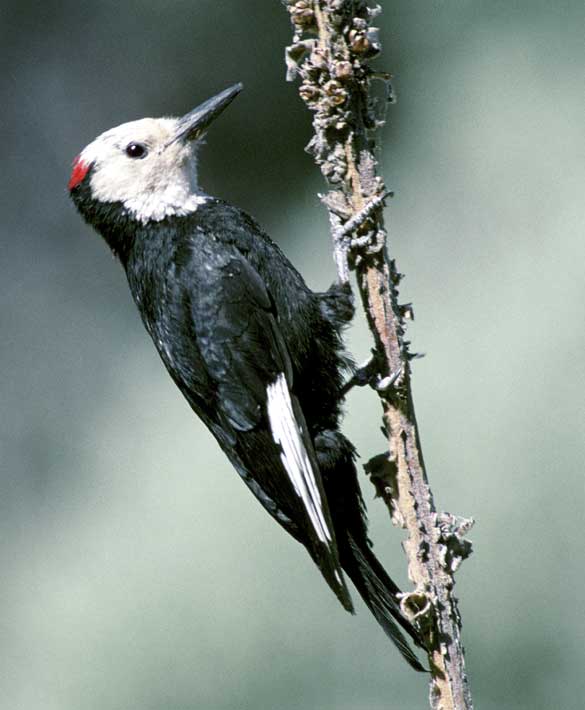
Spring and summer diet
- Ants, beetle larvae and pine seeds
Fall and winter diet
- Ponderosa and sugar pine seeds
Best feeder foods
- Suet
- Black-oil sunflower
A ponderosa-pine specialist of western mountains; visits cabin feeders in pine country.
Where white-headed woodpeckers need winter food
Regions where white-headed woodpeckers are present in the cold months:
Where and when you'll see white-headed woodpeckers
Across the 6 US states and Canadian provinces where we have range data for the White-headed Woodpecker, it is a year-round resident in 6, a summer breeder in 0, a winter visitor in 0. That makes it largely resident: in most of its range the same birds use a yard through every season, so a steady year-round food and water supply pays off.
Nesting starts earliest in California (March–July) and latest in British Columbia (May–July) — a 2-month spread driven by latitude and spring warm-up. Insect food and nest sites matter most in your own region's window.
Food demand during nesting
A White-headed Woodpecker pair lays 3–7 eggs eggs, incubates for 14 days and feeds the young in the nest for 26 days, raising 1 per season brood(s) a year. That is the period when the adults' foraging shifts hardest toward soft, protein-rich food: ants, beetle larvae and pine seeds.
Feeders help the adults, but nestlings are raised mostly on natural prey, so pesticide-free shrubs and native plants matter more than seed in these weeks. Nest site: cavity in a pine snag or stump.
White-headed Woodpecker feeding calendar
What to prioritise each month, based on when white-headed woodpeckers nest somewhere in North America (March–July) and what they eat in each season. Shift the nesting rows a few weeks earlier in the South and later in the North.
| Month | Nesting | Feeding focus |
|---|---|---|
| January | — | High-fat winter food — Ponderosa and sugar pine seeds |
| February | — | High-fat winter food — Ponderosa and sugar pine seeds |
| March | Yes | Protein for nestlings — Ants, beetle larvae and pine seeds |
| April | Yes | Protein for nestlings — Ants, beetle larvae and pine seeds |
| May | Yes | Protein for nestlings — Ants, beetle larvae and pine seeds |
| June | Yes | Protein for nestlings — Ants, beetle larvae and pine seeds |
| July | Yes | Protein for nestlings — Ants, beetle larvae and pine seeds |
| August | — | Natural food peak — Ants, beetle larvae and pine seeds |
| September | — | Natural food peak — Ants, beetle larvae and pine seeds |
| October | — | Migration fuel — Suet |
| November | — | Migration fuel — Black-oil sunflower |
| December | — | High-fat winter food — Ponderosa and sugar pine seeds |
Native plants that feed white-headed woodpeckers
Ranked by how many states and provinces list each plant for the White-headed Woodpecker. Planting these supplies food when feeders are empty and insects for nestlings.
- Douglas fir Pseudotsuga menziesii
Tree · listed in 6 regions. Seed for crossbills, siskins and chickadees.
- Ponderosa pine Pinus ponderosa
Tree · listed in 6 regions. Seeds and bark insects; pygmy nuthatch and woodpecker habitat.
- Rocky Mountain juniper Juniperus scopulorum
Tree · listed in 5 regions. Berry-like cones feed bluebirds, solitaires and waxwings in winter.
- Black spruce Picea mariana
Tree · listed in 1 region. Persistent cones in boreal bogs.
- Tamarack Larix laricina
Tree · listed in 1 region. Deciduous conifer with small cones for siskins and redpolls.
- White spruce Picea glauca
Tree · listed in 1 region. Cone crops drive winter irruptions of finches and crossbills.
Full guide: how to attract white-headed woodpeckers →
Birds that share the White-headed Woodpecker's menu
These species take at least two of the same feeder foods as the White-headed Woodpecker, so the same offering will draw them too — useful for planning, and a warning if a larger bird on this list tends to crowd the feeder.
- Black-capped Chickadee (4.7–5.9 in) — shares black-oil sunflower, suet
- Blue Jay (9.8–11.8 in) — shares black-oil sunflower, suet
- Brown-headed Nuthatch (3.9–4.3 in) — shares black-oil sunflower, suet
- Brown-headed Nuthatch (3.9–4.3 in) — shares black-oil sunflower, suet
- Carolina Chickadee (3.9–4.7 in) — shares black-oil sunflower, suet
- Chestnut-backed Chickadee (4.3–4.7 in) — shares black-oil sunflower, suet
Frequently asked
What do white-headed woodpeckers eat?
Pine seeds pried from cones, plus bark insects.
What is the best food to feed white-headed woodpeckers?
Suet, Black-oil sunflower.
What do white-headed woodpeckers eat in winter?
Ponderosa and sugar pine seeds.
Sources
- White-headed Woodpecker — All About Birds, Cornell Lab of Ornithology
- White-headed Woodpecker life history — Cornell Lab of Ornithology
- White-headed Woodpecker — Audubon Guide to North American Birds
- NestWatch nest box plans and species requirements — Cornell Lab
Timing reflects typical patterns for the region as a whole; local dates vary with elevation and year. Check the linked eBird bar charts for your county.