Keep Squirrels Off a Shepherd's Hook and Out of Feeders
Squirrels beat most feeder setups because the setup gives them a jump-off point. Here's the distance math, baffle sizing and hardware that actually hold — and what to do if squirrels have already won.
9 min read · Updated 2026-10-24
Equipment for this job
For a shepherd's hook, check the pole-collar baffle option and shaft fit. A caged feeder adds another barrier, but neither product replaces safe clearance from jump-off points.
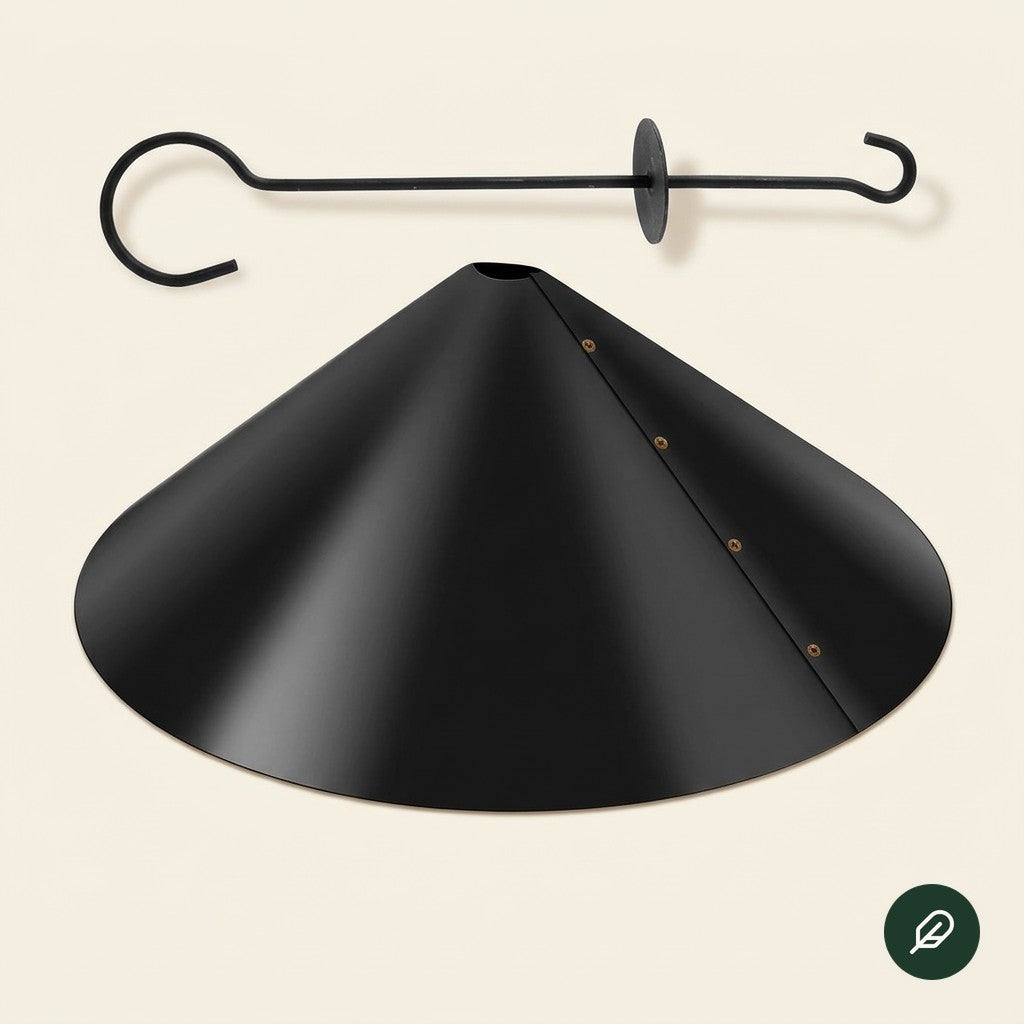
18-Inch Squirrel Baffle
A wide black baffle for helping keep squirrels from reaching a hanging or pole-mounted feeder. The cone measures 18 inches (45.7 cm) across. Choose the hanging-hook setup or pole-collar setup to suit your feeder station. Position the baffle so squirrels cannot bypass it from a nearby branch, railing, or roof.
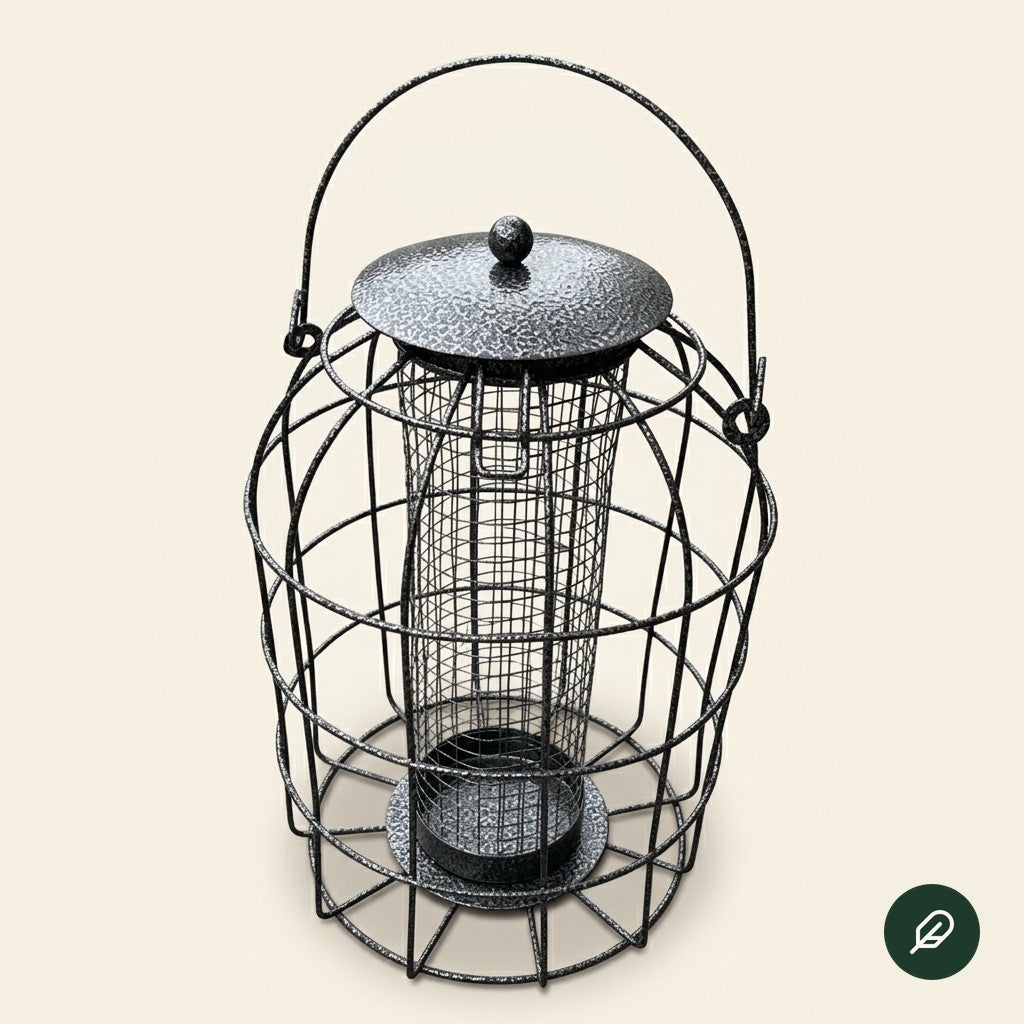
Caged Tube Bird Feeder
A metal tube feeder inside a wide protective cage. The outer cage limits access by squirrels and larger birds while smaller birds can reach the inner seed tube. A top handle makes it easy to hang, and the lid lifts for refilling. Available in black or green. No feeder is completely squirrel-proof, so placement still matters.

- Horizontal jump
- Gray squirrels leap 8–10 ft from a branch or fence
- Drop distance
- Will fall 10+ ft and land on a feeder
- Baffle placement
- Pole: 4–5 ft up, 18 in wide. Hanging: 18 in wide, above the feeder
- Squirrel clearance rule
- Feeders need 10 ft of nothing to jump from, 5 ft off the ground
- Seed squirrels ignore
- Safflower (cardinals, chickadees, doves still eat it)
Shepherd's hook: block the straight climb first
A shepherd's hook gives a squirrel a continuous route from the ground to the feeder. Put a pole-mounted baffle on the straight shaft below the curved arm, using the collar intended for that pole diameter. A dome above a hanging feeder serves a different route; it does not automatically stop a squirrel climbing the hook and reaching sideways onto the feeder.
Before ordering a baffle, measure the shaft where its collar will sit. Check whether the baffle opens around an installed pole or must slide over an end, and whether the collar can clamp securely. With a double hook, check both feeder arms: an unprotected second feeder or a nearby branch can create a bridge around the protected route. Follow the baffle maker's installation height and clearance instructions rather than assuming one dimension fits every hook.
Our 18-inch baffle offers separate hanging-hook and pole-collar setups. Choose the pole-collar option for a straight shepherd's-hook shaft, and verify collar fit in the listing before purchase. Moving the entire hook away from branches, fences, roofs and deck rails remains essential; no collar can block a jump that bypasses it.
- Watch the approach: climbing the shaft and jumping from a fence need different fixes.
- Check pole diameter, collar attachment and installation method before ordering.
- Keep the baffle below the feeder arms; remove branches or objects that bridge around it.
- Never grease the pole or use sticky insect barriers where birds can brush against them.
- Cornell Lab of Ornithology, How to Choose the Right Kind of Bird Feeder
- National Audubon Society, How to Stop Squirrels from Raiding Your Bird Feeders
Why squirrels win at most yards
An Eastern Gray Squirrel can jump roughly eight to ten feet horizontally from a standstill, launch itself farther downhill, survive a drop of well over ten feet, and climb anything with texture — wood poles, shepherd hooks, tree trunks, brick, vinyl siding. A fox squirrel does the same, slightly larger. Any feeder that sits within ten horizontal feet of a jump-off point, or less than five vertical feet above the ground with an unobstructed pole, is within a squirrel's reach. That is the whole problem in one sentence, and it explains why swapping feeders rarely fixes anything on its own.
So the fix is not one gadget. It is three things done together: the feeder sits outside the jump envelope, the access route it does have is interrupted by a correctly sized baffle, and the food inside is either hard to reach or not worth the effort. Miss one leg and a determined squirrel re-solves the puzzle in an afternoon. Squirrels are compensating for a brain the size of a walnut by trying hundreds of approaches; most of our failures come from trying one approach and calling the species clever when it works.
Step 1: place the feeder outside the jump envelope
Before buying anything, look at your feeder's surroundings from the squirrel's point of view. Measure the horizontal gap to the nearest branch, fence rail, deck rail, roof edge, clothesline, or woodpile. If any of those is inside ten feet, the feeder is compromised no matter what hangs on it. The cheapest squirrel-proofing is moving the feeder: a pole set in open lawn, eight to ten feet from every tree drip line and fence, with a wide baffle on the pole, defeats most squirrels with zero other hardware.
Height matters too. The feeder's seed ports or tray should sit at least five feet above the ground so a squirrel cannot simply stand up and grab. Four to six feet is also the human-friendly range for filling and cleaning, so there is no trade-off. If you feed on a deck, expect trouble: deck rails are perfect launch pads, and squirrels will work down the support posts. On decks, hanging feeders from a pole or bracket that stands above rail height, with a top-mounted baffle, is the only arrangement that reliably holds.
- 10 ft horizontal clearance from every launch point — branches, fences, roofs, wires.
- 5 ft minimum vertical distance from the ground to the seed level.
- Avoid mounting directly on tree trunks; that is a squirrel highway with no defense.
- Check the drop path: squirrels will free-fall onto a feeder from a branch 10 ft above.
Step 2: baffle the access route — correctly sized
A baffle is a smooth, wide barrier the squirrel cannot get a grip on. Two kinds do the work. A pole-mounted dome or stovepipe baffle, mounted on the pole itself, blocks the climb from below. For it to hold, three numbers must be right: it sits at least four feet off the ground (below arm's reach from the ground, so the squirrel cannot jump past it), it is at least sixteen to eighteen inches across (a fourteen-inch dome gets hugged and squeezed past), and there is a clear two-to-three-foot run of bare pole below it so the squirrel meets it in mid-climb rather than from the top of a woodpile.
A hanging baffle — a wide dome mounted over the feeder on the wire or chain — blocks the branch-drop and tightrope-wire approach. It needs the same eighteen-inch width, and it must be fixed to the support, not floating on the cord where a squirrel can push it aside. Anything wobbly eventually loses. If your feeder hangs from a shepherd's hook, the baffle goes on the hook's pole; if it hangs from a branch, prune back the branches within ten feet first, then add the top dome.
- Pole baffle: 16–18+ in wide, mounted 4–5 ft up, 2–3 ft of bare pole below.
- Hanging dome: 18 in wide, rigidly fixed above the feeder.
- Metal baffles outlast plastic; raccoons and bears will destroy thin plastic ones.
- Grease and petroleum jelly on poles are unsafe — birds can get it in their feathers.
Step 3: feeders that are hard to open
Placement and baffles do most of the work, but feeder design is the backstop. Caged tube feeders surround the seed ports with a wire grid: songbirds reach through the gaps, squirrels (and grackles, doves, jays) cannot fit their heads and paws to the ports. Weight-activated feeders slam ports shut when something heavy lands; they work but need adjustment and cleaning discipline, and a young squirrel's weight sometimes passes the threshold.
Whatever you buy, two specs matter more than the marketing. First, seed capacity you can finish in two to three days — a feeder that holds a week of seed is a squirrel prize and spoils in rain. Second, all-metal ports, perches and hardware; squirrels chew plastic ports into wide-open funnels within weeks, at which point the 'squirrel-proof' label is nostalgia. A metal-cage or metal-port feeder with a lifetime baffle is a buy-once setup; plastic anything is a subscription to replacements.
Step 4: make the food not worth it
Squirrels eat sunflower, peanuts, corn and almost anything else you offer, but they strongly dislike safflower — bitter to them, ignored by most of them, while cardinals, chickadees, titmouses, nuthatches and doves eat it readily. A safflower-only feeder is the quietest way to reduce squirrel pressure in a yard where moving the feeder is impossible. Nyjer (thistle) for finches is also largely ignored by squirrels, mostly because the tiny ports make it inefficient to raid.
What you should stop doing: corn and loose peanuts are squirrel magnets with low bird value; cheap mixes full of milo and corn get flung out by birds and hoovered up by squirrels, teaching them that your yard pays out. Feed less total volume, feed fresh seed that pours clean, and rake up hulls and spillage weekly — spilled seed under the feeder trains ground-raiding behavior that then graduates to the feeder itself.
- Switch one feeder to pure safflower; keep sunflower in the squirrel-defended feeder.
- Skip corn, loose peanuts and cheap mixes entirely if squirrels are the problem.
- Clean up spilled seed weekly — ground feeding is the gateway to pole climbing.
- A dedicated squirrel-feeding station (corn at the far edge of the yard) sometimes diverts them; results vary by yard.
A realistic expectation
In a yard with mature oaks, some squirrels will still occasionally reach a feeder — riding the baffle, dropping from unpruned limbs, or waiting below for spillage. The realistic goal is a feeder that costs them more effort than the seed is worth, so your cardinals and chickadees get the lion's share. Once the setup holds for two weeks, most squirrels in the territory give up on it permanently and go back to acorns; they are territorial, and the ones that learned your feeder will move on or die of old age eventually.
What never works: hot-pepper 'squirrel-proof' seed is marketed widely. Capsaicin deters mammals in theory, but it can irritate eyes around feeders and studies of its effect on birds' food choice are thin; we don't recommend relying on it. Squirrels also return to retest a defeated setup seasonally — expect a retest in early spring and again in fall, and tighten whatever they loosen.
Frequently asked
How do I keep squirrels off a shepherd's hook?
Fit a pole-mounted baffle to the straight shaft below the feeder arms and move the hook away from launch points such as trees, fences and deck rails. Check the baffle's collar diameter and installation instructions before buying; a hanging dome alone may leave the climbing route open.
How high should a bird feeder be to keep squirrels off?
Seed ports at least 5 ft above the ground, and 10 ft of horizontal clearance from any branch, fence or roof. Height alone doesn't work if a squirrel can jump from nearby — the combination is what holds.
Do squirrel baffles really work?
Yes, when sized and placed right: at least 16–18 in wide, mounted 4–5 ft up a pole (or rigidly fixed above a hanging feeder), with a clear approach below. Undersized or wobbly baffles fail.
What seed do squirrels hate?
Safflower. Cardinals, chickadees, nuthatches and doves eat it happily; most squirrels avoid it. Nyjer for finches is also largely ignored.
Is Vaseline or grease on the pole a good idea?
No. Grease can mat feathers and harm birds, and it drips in heat. Use a physical baffle instead.
More troubleshooting
- Why Birds Stopped Coming to Your Feeder (and What to Do by Season)
- Keeping House Sparrows Out of Bluebird and Chickadee Boxes
- A Hawk Is Hunting at My Bird Feeder: What It Means and What to Do
- How to Get Rid of Grackles at Your Feeders (Without Losing the Birds You Want)
- How to Keep Starlings Off Your Feeders (Suet, Seed and Nest-Box Problems)
- How to Stop Raccoons Raiding Your Bird Feeders (and Your Nest Boxes)
- Bears and Bird Feeders: When to Take Feeders Down (and How to Feed Birds in Bear Country)
- How to Stop Rats and Mice Moving In Under Your Bird Feeders
- Bird Feeder Placement: Height, Distance and Sightlines That Actually Work
- How to Keep Cats Away From Your Bird Feeders (Yours and the Neighbors')
- Sick Birds at Your Feeder: House Finch Eye Disease, Salmonella and What To Do
- How to Keep Crows and Jays From Taking Over Your Feeders
- Why a Woodpecker Is Pecking Your House (and How to Make It Stop)
- Choosing and Placing a Bird Bath: Depth, Material, Moving Water and Location
- How to Clean a Bird Bath: Algae, Safe Cleaning and Mosquitoes
- Bird Bath Water Through the Seasons: Freezing Winters and Summer Heat
- Why Birds Won't Use Your Bird Bath: 8 Common Reasons and Fixes
- Window Bird Feeders in the UK: Which Birds Use Them and How to Make One Stick
- How to Set Up a Bird Feeding Station in a UK Garden
- Robin Bird Box: Open-Front Design, Height and Where to Put It
- Squirrel-Proof Bird Feeders in the UK: What Stops Grey Squirrels
- Bird Baths for UK Gardens: Depth, Placement and Keeping Ice Off
- Heated Bird Baths in Canada: Keeping Water Open at -20°C
- Winter Bird Feeding in Canada: Foods, Feeders and What Shows Up
- Squirrel-Proof Bird Feeders in Canada: Red, Grey and Black Squirrels
- Bird Feeders for Condos and Balconies in Canada
- How to Attract Chickadees in Canada: Food, Nest Boxes and Winter Care
- Caged Bird Feeders: Keep Out Squirrels, Starlings and Grackles
- Upside-Down Suet Feeders: Feed Woodpeckers, Not Starlings
- Window Bird Feeders: Which Ones Stay Up, and Which Birds Come
- Bird Feeder Pole Setup: Height, Depth and Baffle Placement
- Deck Railing Bird Feeders: Mounting, Mess and Squirrels