What do white-winged crossbills eat?
Spruce and tamarack seeds pried from cones.
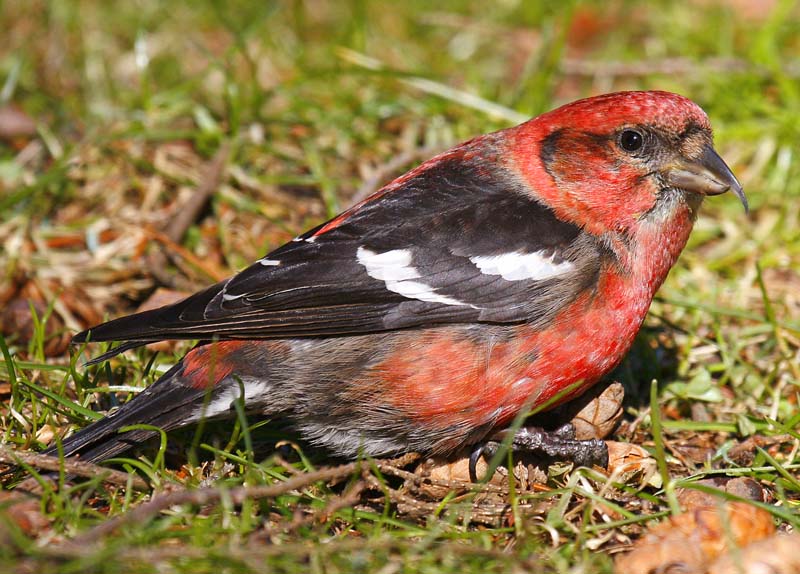
Spring and summer diet
- Spruce, larch and hemlock seeds
Fall and winter diet
- Conifer seeds; occasional sunflower
Best feeder foods
- Hulled sunflower
- Black-oil sunflower
Wanders the boreal forest chasing spruce cone crops; nests in any month cones are ripe.
Where white-winged crossbills need winter food
Regions where white-winged crossbills are present in the cold months:
Where and when you'll see white-winged crossbills
Across the 55 US states and Canadian provinces where we have range data for the White-winged Crossbill, it is a year-round resident in 26, a summer breeder in 0, a winter visitor in 29. That makes it largely migratory: most backyards see it for part of the year only, so feeding and planting should be timed to its arrival.
Nesting starts earliest in Connecticut (January–December) and latest in Yukon (February–December) — a 1-month spread driven by latitude and spring warm-up. Insect food and nest sites matter most in your own region's window.
Food demand during nesting
A White-winged Crossbill pair lays 2–5 eggs eggs, incubates for 12–14 days and feeds the young in the nest for 16–22 days, raising 1–2 per season brood(s) a year. That is the period when the adults' foraging shifts hardest toward soft, protein-rich food: spruce, larch and hemlock seeds.
Feeders help the adults, but nestlings are raised mostly on natural prey, so pesticide-free shrubs and native plants matter more than seed in these weeks. Nest site: cup on a spruce branch; can nest mid-winter.
White-winged Crossbill feeding calendar
What to prioritise each month, based on when white-winged crossbills nest somewhere in North America (January–December) and what they eat in each season. Shift the nesting rows a few weeks earlier in the South and later in the North.
| Month | Nesting | Feeding focus |
|---|---|---|
| January | Yes | Protein for nestlings — Spruce, larch and hemlock seeds |
| February | Yes | Protein for nestlings — Spruce, larch and hemlock seeds |
| March | Yes | Protein for nestlings — Spruce, larch and hemlock seeds |
| April | Yes | Protein for nestlings — Spruce, larch and hemlock seeds |
| May | Yes | Protein for nestlings — Spruce, larch and hemlock seeds |
| June | Yes | Protein for nestlings — Spruce, larch and hemlock seeds |
| July | Yes | Protein for nestlings — Spruce, larch and hemlock seeds |
| August | Yes | Protein for nestlings — Spruce, larch and hemlock seeds |
| September | Yes | Protein for nestlings — Spruce, larch and hemlock seeds |
| October | Yes | Protein for nestlings — Spruce, larch and hemlock seeds |
| November | Yes | Protein for nestlings — Spruce, larch and hemlock seeds |
| December | Yes | Protein for nestlings — Spruce, larch and hemlock seeds |
Native plants that feed white-winged crossbills
Ranked by how many states and provinces list each plant for the White-winged Crossbill. Planting these supplies food when feeders are empty and insects for nestlings.
- Eastern red cedar Juniperus virginiana
Tree · listed in 37 regions. Dense evergreen roost cover and bluish 'berries' eaten through winter.
- Eastern white pine Pinus strobus
Tree · listed in 32 regions. Seed-rich cones and year-round shelter.
- Tamarack Larix laricina
Tree · listed in 31 regions. Deciduous conifer with small cones for siskins and redpolls.
- Eastern hemlock Tsuga canadensis
Tree · listed in 27 regions. Small cones for siskins and chickadees; dense winter roosting.
- Balsam fir Abies balsamea
Tree · listed in 25 regions. Spruce-budworm habitat and dense winter roosting cover.
- White spruce Picea glauca
Tree · listed in 24 regions. Cone crops drive winter irruptions of finches and crossbills.
Full guide: how to attract white-winged crossbills →
Birds that share the White-winged Crossbill's menu
These species take at least two of the same feeder foods as the White-winged Crossbill, so the same offering will draw them too — useful for planning, and a warning if a larger bird on this list tends to crowd the feeder.
- Black-capped Chickadee (4.7–5.9 in) — shares black-oil sunflower, hulled sunflower
- Downy Woodpecker (5.5–6.7 in) — shares black-oil sunflower, hulled sunflower
- House Finch (5.1–5.5 in) — shares black-oil sunflower, hulled sunflower
- Pine Grosbeak (7.9–9.8 in) — shares black-oil sunflower, hulled sunflower
- Purple Finch (4.7–6.3 in) — shares black-oil sunflower, hulled sunflower
- Red Crossbill (5.5–6.7 in) — shares black-oil sunflower, hulled sunflower
Frequently asked
What do white-winged crossbills eat?
Spruce and tamarack seeds pried from cones.
What is the best food to feed white-winged crossbills?
Hulled sunflower, Black-oil sunflower.
What do white-winged crossbills eat in winter?
Conifer seeds; occasional sunflower.
Sources
- White-winged Crossbill — All About Birds, Cornell Lab of Ornithology
- White-winged Crossbill life history — Cornell Lab of Ornithology
- White-winged Crossbill — Audubon Guide to North American Birds
Timing reflects typical patterns for the region as a whole; local dates vary with elevation and year. Check the linked eBird bar charts for your county.