The best feeder for black-throated sparrows
Comes to ground seed and water in desert yards; can go long stretches without drinking in the wild.
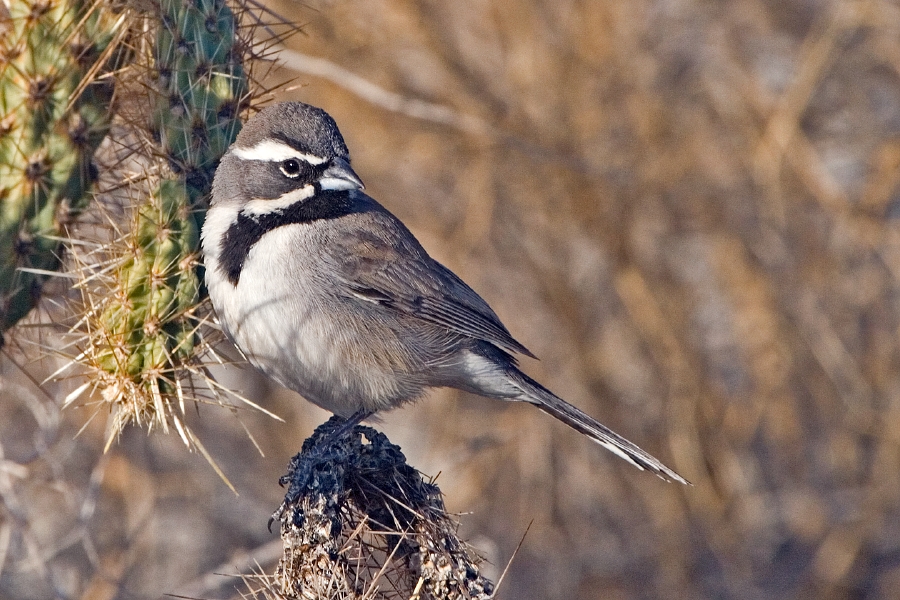
Feeder styles that work
Mimics natural ground foraging; place within 10 ft of shrubs.
Water often attracts this species more than food.
What to fill it with
- Millet
- Cracked corn (on the ground)
Sizing the feeder to the bird
The Black-throated Sparrow measures 4.7–5.5 in and weighs 0.4–0.5 oz. Perches, ports and landing surfaces need to fit that frame — too small and the bird can't feed comfortably, too open and larger birds and squirrels dominate.
Keep it clean
Scrub feeders every two weeks in hot soapy water, soak 10 minutes in a 1:9 bleach solution, rinse and dry before refilling. Rake up hulls underneath.
When to have a feeder up for black-throated sparrows
Across the 10 US states and Canadian provinces where we have range data for the Black-throated Sparrow, it is a year-round resident in 10, a summer breeder in 0, a winter visitor in 0. That makes it largely resident: in most of its range the same birds use a yard through every season, so a steady year-round food and water supply pays off.
Nesting starts earliest in Arizona (February–July) and latest in Wyoming (April–July) — a 2-month spread driven by latitude and spring warm-up. Insect food and nest sites matter most in your own region's window.
One feeder, several birds
These species take at least two of the same feeder foods as the Black-throated Sparrow, so the same offering will draw them too — useful for planning, and a warning if a larger bird on this list tends to crowd the feeder.
- Blue Grosbeak (5.5–6.3 in) — shares millet, cracked corn
- Brewer's Blackbird (7.9–9.8 in) — shares cracked corn, millet
- Brown-headed Cowbird (7.5–8.7 in) — shares millet, cracked corn
- California Quail (9.4–10.6 in) — shares millet, cracked corn
- Canyon Towhee (8.3–9.1 in) — shares millet, cracked corn
- Eastern Meadowlark (7.5–10.2 in) — shares cracked corn, millet (on open ground)
Native plants that feed black-throated sparrows
Ranked by how many states and provinces list each plant for the Black-throated Sparrow. Planting these supplies food when feeders are empty and insects for nestlings.
- Common sunflower Helianthus annuus
Perennial · listed in 10 regions. Annual native sunflower — the original feeder seed.
- Little bluestem Schizachyrium scoparium
Perennial · listed in 10 regions. Native bunchgrass; winter seed and ground cover for sparrows and juncos.
- Tall goldenrod Solidago altissima
Perennial · listed in 10 regions. Insect-rich in fall and seed in winter.
- Wild bergamot Monarda fistulosa
Perennial · listed in 10 regions. Tubular flowers for hummingbirds and seed heads for finches.
Full guide: how to attract black-throated sparrows →
Other new world sparrows (passerellidae) in our guides
Frequently asked
What kind of feeder is best for black-throated sparrows?
Low ground tray under cover. Mimics natural ground foraging; place within 10 ft of shrubs.
What should I put in a feeder for black-throated sparrows?
Millet, Cracked corn (on the ground).
Where should I place a feeder for black-throated sparrows?
Comes to ground seed and water in desert yards; can go long stretches without drinking in the wild.
Sources
- Black-throated Sparrow — All About Birds, Cornell Lab of Ornithology
- Black-throated Sparrow life history — Cornell Lab of Ornithology
- Black-throated Sparrow — Audubon Guide to North American Birds
Timing reflects typical patterns for the region as a whole; local dates vary with elevation and year. Check the linked eBird bar charts for your county.