Cardinals and allies (Cardinalidae)
Baby rose-breasted grosbeaks: from egg to fledgling
A Rose-breasted Grosbeak lays 1–5 eggs. They hatch after 11–14 days, and the young leave the nest 9–12 days later — about 20–26 days from egg to fledgling.
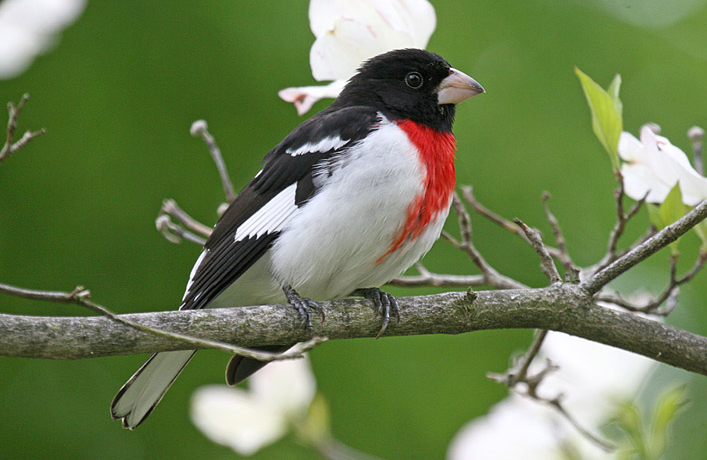
- Eggs per clutch
- 1–5 eggs
- Incubation
- 11–14 days
- Time in the nest
- 9–12 days
- Egg to fledgling
- About 20–26 days
- Broods per year
- 1–2 per season
- Nest
- Flimsy twig cup in deciduous trees 5–15 ft up
- Uses nest boxes
- No
Stage by stage
- Eggs (11–14 days): 1–5 eggs per clutch. Most songbirds start incubating when the last or second-to-last egg is laid, so the young hatch close together; owls and hawks start with the first egg, so their chicks hatch days apart.
- Nestlings (9–12 days): the young hatch with little or no down and their eyes closed. They grow fast on a diet the parents bring in. In the breeding season rose-breasted grosbeaks mainly eat beetles, caterpillars and bees.
- Fledglings: after leaving the nest, young rose-breasted grosbeaks are fully feathered but short-tailed and clumsy. They spend days to weeks on low branches or the ground while the parents keep feeding them.
- More broods: 1–2 per season. Pairs often start a new nest soon after the first young become independent.
When rose-breasted grosbeaks nest, state by state
Nesting starts earliest in Connecticut (May) and latest in Alberta (Jun). Months are estimates from regional breeding data shifted for latitude.
| State / province | Nesting season |
|---|---|
| Alberta | Jun–Jul |
| British Columbia | Jun–Jul |
| Connecticut | May–Jul |
| Illinois | May–Jul |
| Indiana | May–Jul |
| Iowa | May–Jul |
| Kansas | May–Jul |
| Kentucky | May–Jul |
| Maine | Jun–Jul |
| Manitoba | Jun–Jul |
| Maryland | May–Jul |
| Massachusetts | May–Jul |
| Michigan | May–Jul |
| Minnesota | Jun–Jul |
| Missouri | May–Jul |
| Nebraska | May–Jul |
| New Brunswick | Jun–Jul |
| New Hampshire | Jun–Jul |
| New Jersey | May–Jul |
| New York | May–Jul |
| Newfoundland and Labrador | Jun–Jul |
| North Carolina | May–Jul |
| North Dakota | Jun–Jul |
| Northwest Territories | Jun–Jul |
| Nova Scotia | Jun–Jul |
| Ohio | May–Jul |
| Ontario | Jun–Jul |
| Pennsylvania | May–Jul |
| Prince Edward Island | Jun–Jul |
| Quebec | Jun–Jul |
| Rhode Island | May–Jul |
| Saskatchewan | Jun–Jul |
| South Dakota | May–Jul |
| Tennessee | May–Jul |
| Vermont | Jun–Jul |
| Virginia | May–Jul |
| West Virginia | May–Jul |
| Wisconsin | Jun–Jul |
Found a baby Rose-breasted Grosbeak?
- Feathered, hopping, can grip your finger: a fledgling. This is a normal stage. Keep pets and children away and watch from a distance; the parents are usually close by.
- Bare skin or only pin feathers: a nestling that fell. If you can see the nest, put it back. Touching it won't make the parents abandon it — that is a myth.
- Injured, cold, covered in flies, or caught by a cat: contact a licensed wildlife rehabilitator. In the US and Canada, ahnow.org finds the nearest one.
- Don't give water or food. Baby birds can choke, and the wrong food can kill them.
More about rose-breasted grosbeaks
Frequently asked
How long do baby rose-breasted grosbeaks stay in the nest?
About 9–12 days after hatching. Eggs take 11–14 days to hatch, so it is roughly 20–26 days from the last egg to the young leaving.
How many eggs does a Rose-breasted Grosbeak lay?
1–5 eggs per clutch, with 1–2 per season.
Where do rose-breasted grosbeaks nest?
Flimsy twig cup in deciduous trees 5–15 ft up.
What should I do if I find a baby Rose-breasted Grosbeak on the ground?
If it has feathers and hops, it is a fledgling and its parents are almost certainly nearby — leave it. If it is naked or has pin feathers, put it back in the nest if you can. Call a licensed wildlife rehabilitator if it is injured.