Choosing and Placing a Bird Bath: Depth, Material, Moving Water and Location
Most bird baths are too deep, too slick or in the wrong spot. The measurements, materials, placement distances and moving-water options that decide whether birds use one.
14 min read · Updated 2026-10-07
Equipment for this job
Our baths are chosen for shallow, textured basins birds will actually stand in.
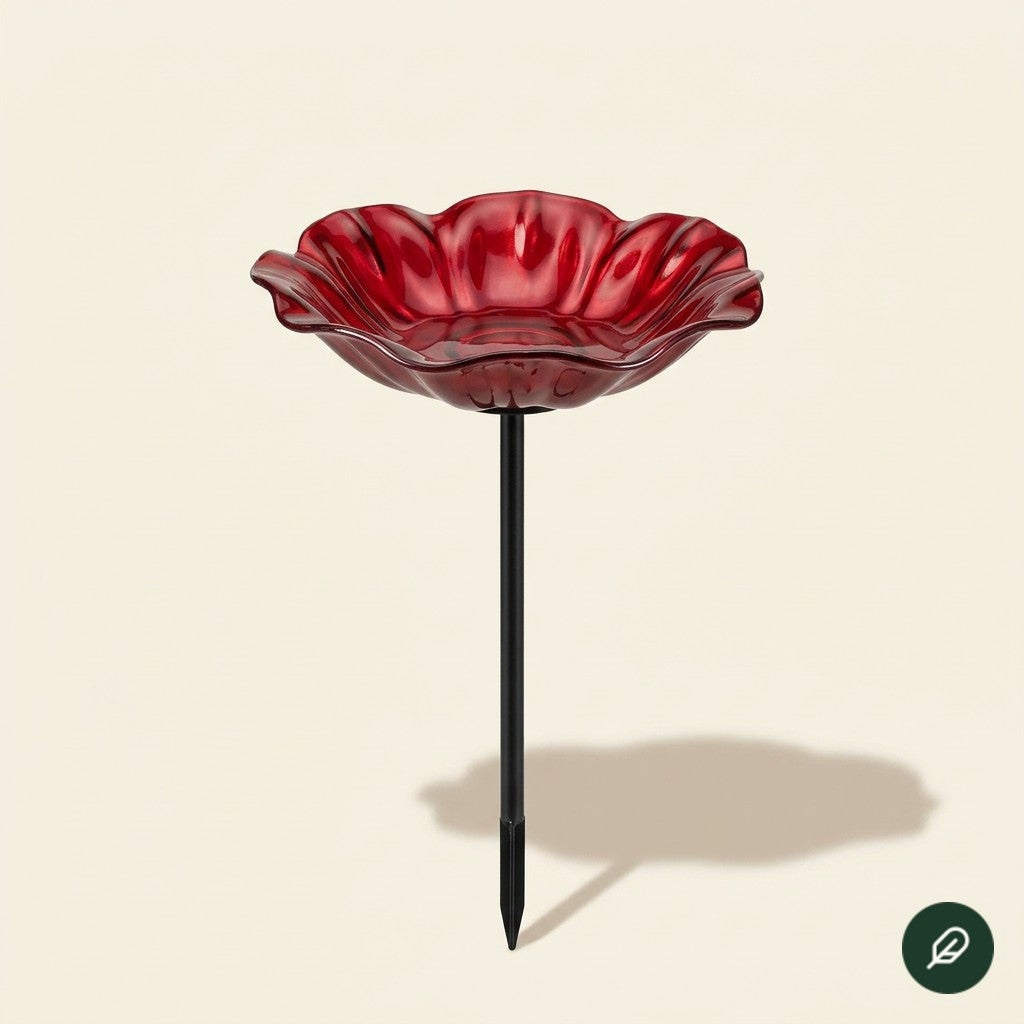
Flower Stake Bird Bath
A flower-shaped bird bath on a slim garden stake. The metal bowl holds water for drinking and bathing, and the dark center gives small birds a textured spot to grip. Push the stake into a flower bed or lawn and it's ready — no tools, no assembly beyond threading the bowl onto the stake. Bowl: 5.1 in (13 cm) across, flower-shaped, painted metal Stake: 17.3 in (44 cm) tall, black metal, pushes into soil Colors: Red, Blue, Orange, Purple Use: water for drinking and bathing; shallow depth suits small songbirds Care: tip out and rinse every few days in summer to keep water fresh and mosquitoes down Best placed near shrubs or cover so birds feel safe stopping to drink. Bring it in over hard freezes to protect the finish.
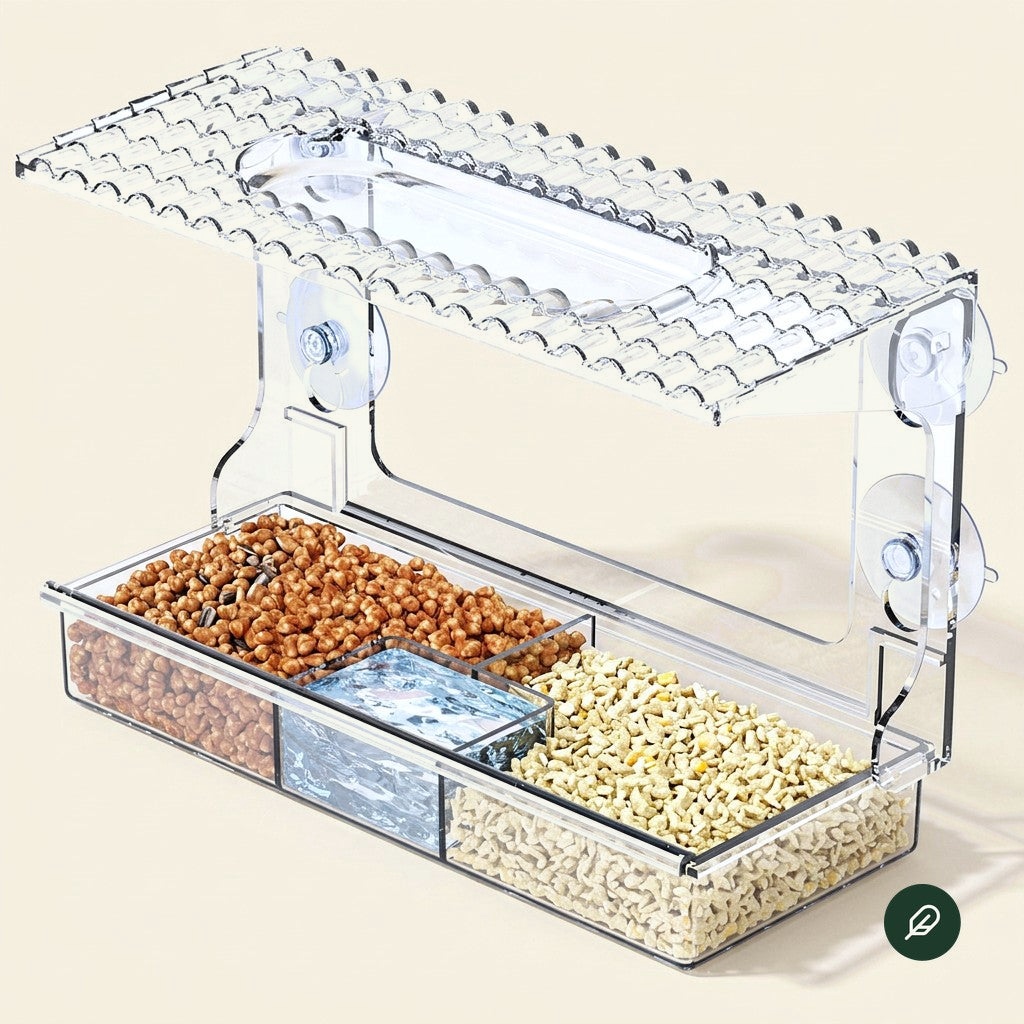
Window Feeder with Roof Bath
A wide clear acrylic window feeder with a textured roof that holds a shallow pool of water for small birds, plus a lift-out tray split into seed and water sections.Specs Clear acrylic, 4 suction cups Removable tray with drainage holes Roof basin catches rain; top it up in dry spells Tips Small birds only; jays and larger birds will crowd it. Pull the tray and rinse it weekly so wet seed doesn't mold.
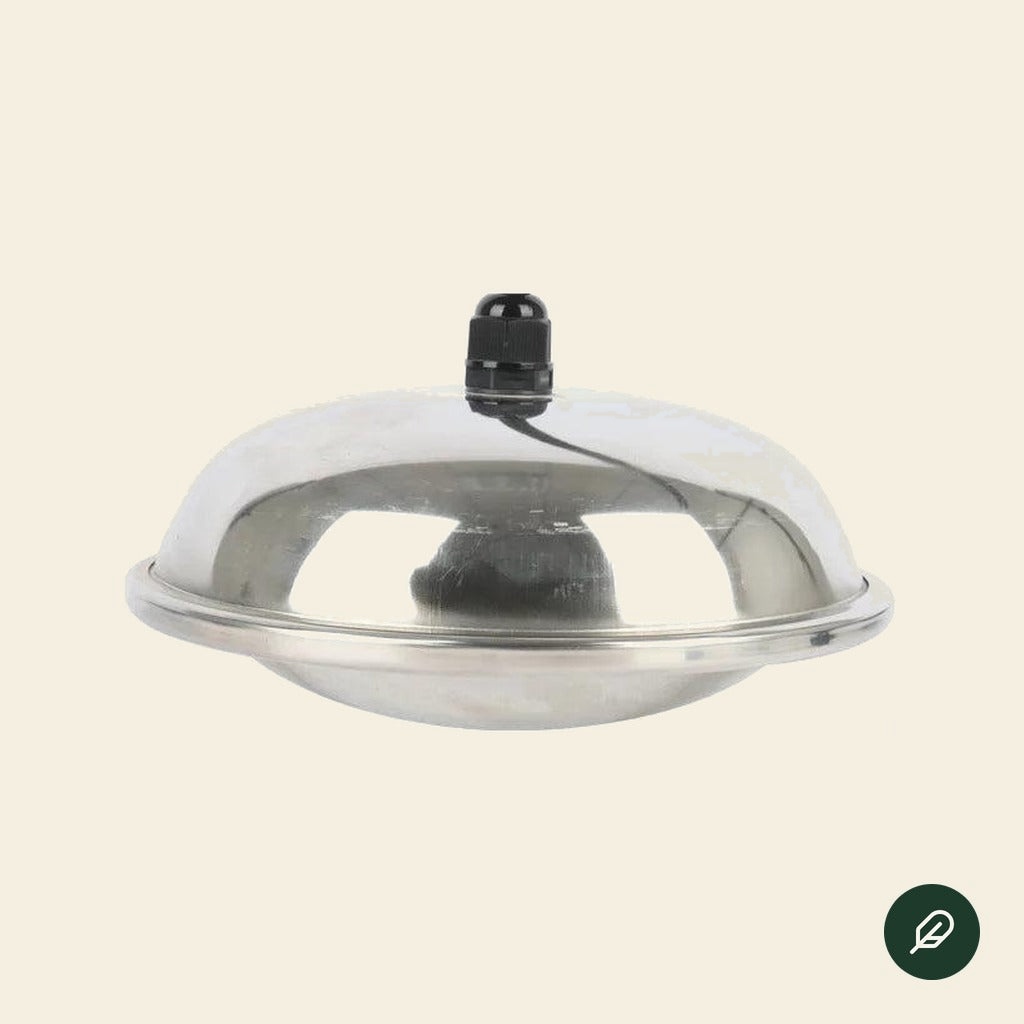
Stainless Steel Pond and Birdbath Deicer
A stainless steel dome heater that sits in a pond or large birdbath and keeps a patch of water open through freezing weather, so birds can still drink and bathe in winter. It has a built-in thermostat and a dry-run cut-off that switches the heater off if it's left out of water. Dimensions: 180 mm (7.1 in) across, 83.9 mm (3.3 in) tall Material: stainless steel dome, black power cord Power options: 100W, 150W, 200W, 250W or 300W. Smaller birdbaths need less power; ponds and very cold areas need more. Weight: about 1.9 kg (4.1 lb) Plug: US 3-prong, 120V Use with a GFCI-protected outdoor outlet. Keep the cord out of reach of pets and away from where people walk.
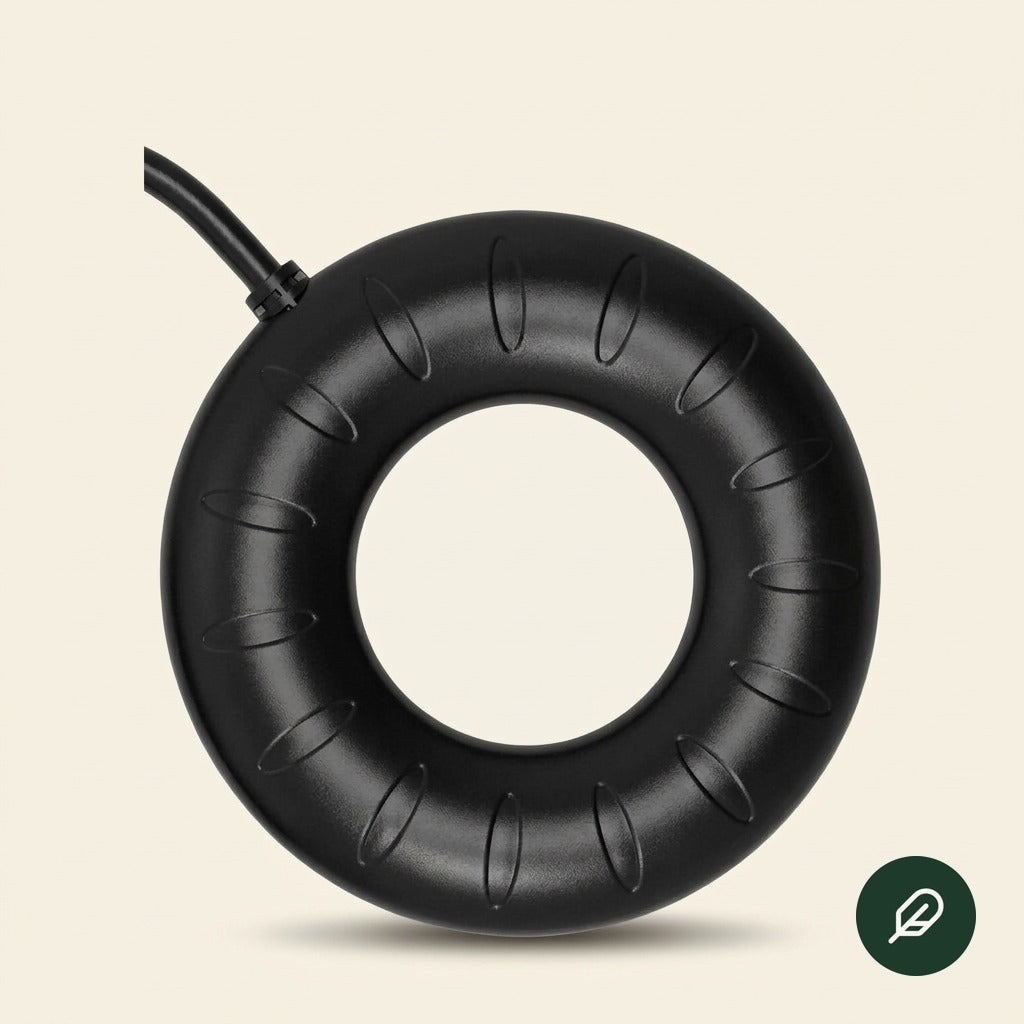
70W Trough and Bath Deicer
A 70-watt submersible deicer that keeps a small open-water area in a bird bath or livestock trough through hard freezes. Runs on standard 120V US household power with a thermostatic control that switches on near freezing and off when the water is ice-free, so it does not run continuously.Specs: 70 W, 120V US plug, submersible sealed element, black housing. Sized for small baths and troughs; it keeps a drinking hole open rather than warming the whole bath — birds only need liquid water, not warm water.Safety note: this is an electrical appliance used outdoors in water. We list it only once a valid UL/ETL safety certification is confirmed. Always plug into a GFCI-protected outdoor outlet and route the cord so birds and pets cannot chew it.

- Ideal depth
- 1 in at the edge, no more than 2 in at the center
- Slope
- Gradual, shallow edge birds can wade into
- Surface
- Rough or textured — smooth glazes are slippery
- Width
- 18–24 in serves several birds at once
- Height
- Pedestal ~2–3 ft, or ground level near cover
- Small songbirds
- About 1 in (chickadees, finches, warblers)
- Medium birds
- 1.5–2 in (robins, cardinals, jays)
- Maximum
- 2 in at the deepest point
- Quick fix
- Flat stones or clean gravel in the basin
What a bird actually needs from a bath
Birds use water for two things: drinking and bathing. Drinking takes a few seconds and almost any dish will do. Bathing is the reason most people buy a bird bath, and it has stricter requirements. A songbird bathes by wading in until the water reaches its belly, then dipping its head and flicking its wings to throw water over its back. A robin or a starling can handle about two inches. A chickadee, goldfinch or warbler wants closer to one inch. Anything deeper and small birds simply perch on the rim, drink, and leave.
That single fact rules out a lot of what is sold. Many decorative baths are three or four inches deep with steep sides, which looks generous to us and looks like a pond to a sparrow. If you already own a deep bath, you do not have to replace it: a few flat stones or a layer of clean gravel in the basin will bring the depth down to something birds will use. But if you are buying new, depth is the first number to check, before color, style or price.
Depth and slope: the numbers that matter
Look for a basin that starts at roughly half an inch to one inch at the edge and slopes gradually to no more than two inches at the deepest point. The slope matters as much as the depth because it lets each bird choose its own spot. Small birds stay on the shallow margin; larger birds move toward the middle. A flat-bottomed bath with a uniform two-inch depth serves robins and jays but leaves out most small songbirds.
Width affects how many birds can use the bath at once and how quickly the water evaporates. A basin of 18 to 24 inches across lets three or four birds bathe together, which matters because birds bathe more readily when other birds are already bathing. Smaller dishes of 10 to 14 inches are fine on a balcony or deck, but plan on refilling them daily in summer because shallow water disappears fast.
- Edge depth: 0.5–1 in. Center depth: 2 in maximum.
- Gentle slope, not a step or a vertical wall.
- 18–24 in across for a yard bath; 10–14 in for a balcony.
- If the bath is too deep, add flat stones rather than replacing it.
Materials compared
Concrete and cast stone are the traditional choice. They are heavy enough that wind and squirrels cannot tip them, and their rough surface gives birds good footing. The downsides are weight (a two-piece concrete bath often weighs 60 to 100 pounds), porosity that lets algae root in, and cracking in climates where water freezes in the basin. If you live where winters freeze hard, a concrete bath needs to be drained and covered or brought in for the winter.
Metal baths — copper, steel, cast iron and aluminum — are lighter and easy to clean, and they do not crack in frost. Metal heats up in direct summer sun, so place metal baths in partial shade. Copper is sometimes advertised as algae-resistant; it does slow some growth, but it does not replace cleaning. Glass and glazed ceramic baths are attractive and easy to scrub but slippery and fragile; if you choose one, add a few rough stones for footing. Resin and plastic baths are the cheapest and lightest, survive freezing well, and are good for renters, but they can blow over and fade in sun.
- Concrete/stone: stable, good grip, heavy, cracks if water freezes in it.
- Metal: light, frost-safe, easy to clean, can get hot in full sun.
- Glazed ceramic/glass: easy to clean, slippery, breaks in frost.
- Resin/plastic: cheap, frost-safe, light enough to tip in wind.
Pedestal, hanging, deck-mounted or ground level
Pedestal baths at two to three feet are the most common design and work well when there is shrub cover within about ten to fifteen feet. That distance gives birds a place to retreat to and dry off, but keeps cats from ambushing them at the basin. Ground-level baths are used readily by thrushes, sparrows, juncos and doves, which naturally drink from puddles, but they are more exposed to cats; put them in open ground with clear sight lines.
Hanging baths and rail-mounted dishes suit decks and small spaces. They are lighter and easier to clean but hold less water. Stake-mounted baths, which push into a garden bed, fill the gap between ground and pedestal height and are simple to move around the yard until you find a spot birds like. Whatever style you choose, it must be level; a tilted basin leaves one side dry and the other too deep.
Features worth paying for, and ones that are not
Moving water is the single feature that most increases bird visits, because birds notice the sound and the glint of light from a distance. A small solar fountain or dripper can be added to almost any basin. A heater or heated basin is worth it in places where water freezes for weeks at a time, since open water in winter is scarcer than food. A removable basin that lifts off the pedestal makes cleaning much easier and is worth choosing over a one-piece design.
Features that add little: built-in ornaments in the middle of the basin that take up bathing space, mirror finishes, and very steep decorative bowls. Also be skeptical of any 'self-cleaning' claims. No bath stays clean without regular scrubbing and water changes; the best a design can do is make that job quicker.
A simple setup that works
For most yards, the reliable choice is a wide, shallow, textured basin on a pedestal or stake, placed in partial shade within ten to fifteen feet of shrubs, with a small fountain or dripper added and the water changed every two or three days. That combination covers the depth, safety, visibility and hygiene requirements without anything complicated. Once birds find it, many yards see more species at the bath than at the feeders, including warblers, thrushes and waxwings that never eat seed.
Start there, watch which birds come and where they stand, and adjust. If small birds only drink from the rim, add stones to make the bath shallower. If nothing comes after two weeks, move it closer to cover or add moving water. A bath is easy to fine-tune once you know what the birds are telling you.
Why depth decides who uses the bath
Birds cannot swim in the way ducks do. A songbird bathing in water too deep for it risks waterlogging its feathers and struggling to get out. They know this, so they test the water with their feet and will not go in if they cannot stand comfortably. The result is that a deep bath gets used for drinking from the rim but rarely for bathing, especially by small species.
The useful depth roughly matches the height of the bird's legs and belly. A goldfinch, chickadee, wren or warbler stands only a few inches tall and wants water around one inch deep. Sparrows and juncos are similar. Robins, cardinals, mockingbirds and jays are comfortable at one and a half to two inches. Very few backyard songbirds want more than two inches.
- Under 1 in: hummingbirds (they prefer misters and drippers), tiny warblers.
- About 1 in: chickadees, titmice, finches, sparrows, wrens, bluebirds.
- 1.5–2 in: robins, thrushes, cardinals, jays, starlings, grackles.
The ideal profile
The best bath is not one depth but a slope: very shallow at the edge, deepening gradually to two inches in the middle. Each bird walks in until it reaches its own comfort level. This is how a natural puddle or stream edge works, and birds evolved to use them. A basin with a flat bottom and steep walls offers only one depth, and it is usually the wrong one for half the birds in your yard.
Measure your bath with a ruler at the edge and the center when filled. If it is deeper than two inches anywhere, or deeper than one inch at the margin, it is worth adjusting.
Fixing a deep bath with stones
The simplest fix is to put flat stones in the basin. Wash them first, then arrange a few so their tops sit just below or just above the waterline. Small birds can stand on them, and the stones break up the deep area into shallower zones. River rock and flagstone pieces work well. Avoid painted or decorative glass stones, which are slippery, and anything with sharp edges.
Another option is a layer of clean pea gravel over the bottom to raise the floor. Gravel gives excellent footing but is harder to clean, because debris settles between the stones. If you use it, lift it out and rinse it in a bucket during your weekly scrub. Large flat stones are easier to maintain than gravel for most people.
- Use washed, natural stones with rough tops.
- Place them so tops sit at or just under the surface.
- Leave open water around them so larger birds can still bathe.
- Remove and rinse stones during the weekly clean.
Footing: the other half of the problem
Even at the right depth, a smooth glazed or glass basin is hard to stand on. Birds slip, and a bird that slips once often will not return. Concrete and unglazed stone have natural grip. For smooth basins, a few rough stones as above, or a ring of rough stone around the shallow edge, solves it. Some people use a small piece of textured, untreated slate. Avoid adding sand, which washes around and clouds the water.
Large basins, ponds and water features
Garden ponds, fountains with deep reservoirs, and large pots of water can drown birds and small mammals that fall in and cannot climb out. If you have any deep water in the yard, add an escape route: a sloping stone, a piece of rough wood, or a shallow shelf at one edge. For ponds, a beach area of flat stones at a gentle angle gives birds a safe place to drink and bathe without going near deep water.
Pet water bowls and buckets left outside also attract birds. A floating stick or stone in a bucket costs nothing and prevents drownings.
Winter and summer depth
In very hot weather, shallow water evaporates faster, so check it daily and top it up rather than making the bath deeper. In winter, some birders keep the bath even shallower, since a soaked bird in sub-freezing air loses heat quickly. If you use a heated bath in winter, birds mostly drink rather than bathe, and that is fine. A shallow heated basin of one to two inches is ideal.
Think like a wet bird
A bathing bird is at its most vulnerable. Wet feathers make flight slower and clumsier, and a bird with its head down in the water is not watching for danger. Birds therefore choose baths that let them see trouble coming and reach safety quickly. That is the logic behind almost every placement rule: close enough to cover to escape, far enough from cover that a cat cannot hide beside the basin.
The commonly cited distance is about ten to fifteen feet from dense shrubs or low trees. Birds can wait in the branches, fly in when the coast looks clear, and retreat to preen and dry afterward. If shrubs grow right up to the basin, a cat can crouch unseen within pouncing range. If the bath is in the middle of an open lawn sixty feet from anything, many birds will not risk it.
Sun and shade
Partial shade is best. Full sun in summer heats shallow water quickly, speeds evaporation, and grows algae within days. Deep shade under a dense tree keeps the water cool but drops leaves, sap and droppings into the basin and can make the bath harder for birds to spot. A spot with morning sun and afternoon shade is a good compromise in most of the US and Canada.
In winter the reverse can be useful. A bath that gets low winter sun stays ice-free a little longer each day. If you keep the bath out year-round without a heater, consider moving it to a sunnier spot from late fall to early spring.
- Summer: morning sun, afternoon shade.
- Avoid placing directly under trees that drip sap or drop berries.
- Winter without a heater: the sunniest sheltered spot you have.
Keep it away from feeders
It is tempting to group the bath and feeders into one bird station, but putting a bath directly under or beside feeders means seed hulls, droppings and spilled food land in the water constantly. That fouls the water quickly and concentrates birds in one spot, which helps disease spread. A gap of several feet is enough; birds will move between feeder and bath easily.
The bath also attracts birds that never visit feeders — warblers, vireos, thrushes, waxwings, tanagers — and those birds may be more comfortable at a bath set a little apart from the busy, noisy feeder crowd.
Windows and collisions
Birds startled from a bath often fly fast and low, sometimes straight into a reflective window. The guidance used for feeders applies to baths too: either place them within about three feet of a window, so a bird leaving cannot build up enough speed to be hurt, or more than thirty feet away, so the window is not in their flight path. The middle distance is the riskiest. If your best viewing spot is in that range, add window markings spaced no more than two inches apart.
Cats, hawks and other predators
Outdoor cats are the leading human-related cause of bird deaths in the United States and Canada, and a bath placed beside low hedges or tall flowers is an ideal hunting spot. Keep the area immediately around the bath open, with short grass or mulch for at least several feet, so birds can see an approach. A pedestal height of two to three feet gives an extra margin.
Hawks such as Cooper's and Sharp-shinned Hawks do sometimes hunt at baths and feeders. That is natural and is not a sign of bad placement. If one starts visiting daily, take the bath down for a week or two; the hawk will move on and the small birds will return.
Practical placement for real yards
Pick a spot you can see from the house, since watching birds bathe is half the reason to have one, and where a hose reaches, since you will change the water every few days. Make sure the ground is level and firm so the bath does not tilt. On a deck or balcony, put a hanging or rail-mounted bath near potted plants or a nearby tree, out of the main foot traffic.
If birds are slow to find a new bath, give it two to three weeks. Adding a dripper or small fountain often shortens that to a few days. If they still ignore it, try moving it closer to cover, five feet at a time, until you find the spot your local birds accept.
Why moving water attracts more birds
Birds find water partly by sound and partly by the flicker of light on a moving surface. A still basin is only visible to birds that fly directly over it or perch nearby. A dripping or bubbling one advertises itself across the yard. Many birders report that adding a dripper or small fountain to an existing bath brings in species they had never seen before, particularly warblers, vireos and thrushes during spring and fall migration, which are drawn to the sound of water as they pass through.
Moving water also tends to stay fresher. Surface movement helps keep mosquitoes from laying eggs, since they prefer calm water, and circulating water is a little slower to grow algae in partial shade. Neither effect replaces regular cleaning, but they help.
Types of moving water
Solar floating fountains are the simplest: a small disk with a solar panel and pump that floats in the basin and sends up a spray. They need no wiring and cost little. Their limitation is that most stop as soon as a cloud passes or the bath falls into shade, unless they include a battery. They also need enough water depth to float and to keep the pump submerged, which can be at odds with the shallow depth small birds want. Placing a few stones to create a shallow zone beside the fountain solves that.
Drippers release a steady drip from above into the basin, usually fed by a hose line or a small reservoir. The drip creates ripples and sound without making the basin deeper, and they are very popular with warblers. Recirculating bubblers sit in the basin and push water gently up through a stone or spout, making a soft burble. Misters spray a fine mist, which hummingbirds fly through to bathe. Plug-in pumps are the most reliable but require an outdoor outlet with ground-fault protection.
- Solar floating fountain: cheap, no wiring, sun-dependent.
- Solar fountain with battery: runs into the evening and on cloudy days.
- Dripper: gentle, shallow-friendly, warbler favorite.
- Mister: hummingbirds bathe in it.
- Plug-in pump: most reliable, needs a safe outdoor outlet.
The trade-offs
Moving water adds cost and maintenance. Pumps pull in hair, feathers and algae and need the intake cleaned every week or two. Spray fountains can splash water out of a shallow bath quickly, emptying it in a hot afternoon; check water level daily so the pump never runs dry, which ruins most small pumps. Solar models have a lifespan of a few seasons in many cases.
Still water, by contrast, costs nothing to run and is easier to clean. If you change it every two to three days, it stays clean and mosquito-free. Plenty of yards have a busy still bath. Moving water is a way to get more birds and more species, not a requirement.
When still water is the better choice
If you cannot check the bath every day in summer, a still bath is safer than a fountain that may run dry or splash itself empty. In winter, a fountain freezes and can be damaged; take pumps indoors once nights drop below freezing, unless they are specifically rated for cold. And in very small baths under about 12 inches, a spray fountain often throws out more water than it keeps.
Setting up a fountain properly
Put the fountain in a wide basin of at least 16 inches, so the spray lands back in the bath. Set the spray low; a gentle bubble attracts birds as well as a tall jet and loses far less water. Place the solar panel where it gets at least six hours of direct sun, even if the basin itself is in partial shade; many models have a separate panel on a cable for this reason. Arrange stones so there is a shallow area away from the spray where small birds can stand.
Clean the pump each time you scrub the bath. Most pumps open to reveal a foam filter and impeller that can be rinsed under a tap. A pump that slows or sputters usually just needs this cleaning.
The bottom line
If you want more birds and you can check the bath daily, add moving water. A dripper or a low solar bubbler in a wide, shallow basin gives the biggest improvement for the least trouble. If you prefer a no-maintenance setup, a still bath with fresh water every few days still provides one of the most valuable resources in your yard.
Frequently asked
How deep should a bird bath be?
About 1 inch at the edge and no more than 2 inches at the deepest point, with a gradual slope so small and large birds can each find a comfortable depth.
What is the best material for a bird bath?
Concrete gives the best grip and stability but cracks if water freezes in it. Metal and resin survive frost and are easier to clean. Glazed baths are easy to scrub but slippery, so add rough stones.
Should a bird bath be on the ground or on a pedestal?
Both work. Pedestals at 2–3 feet are safer from cats; ground baths attract thrushes, sparrows and doves. Either way, keep shrub cover 10–15 feet away.
Do birds prefer moving water?
Yes. The sound and movement of a dripper or small fountain draw birds from much farther away than still water.
How deep should water be in a bird bath?
About 1 inch at the edge and up to 2 inches at the center. Small songbirds want about 1 inch; robins and jays can handle 2.
My bird bath is too deep — what can I do?
Add washed flat stones or a layer of clean gravel to raise the floor and create shallow standing spots.
Can birds drown in a bird bath?
In very deep or steep-sided water, yes. Keep baths under 2 inches and add an escape stone to any deep water feature.
Why do birds only drink from the rim of my bath?
It is usually too deep or too slippery. Add rough stones to make shallow, grippy footing.
Should a bird bath be in sun or shade?
Partial shade. Morning sun and afternoon shade keeps the water cooler, slows algae and still lets birds see the water.
How far should a bird bath be from bushes?
About 10–15 feet. Close enough for birds to escape and dry off, far enough that cats cannot hide beside the basin.
Can I put a bird bath next to my feeders?
Keep it a few feet away, not underneath. Seed hulls and droppings foul the water quickly.
How close to a window should a bird bath be?
Within 3 feet or more than 30 feet, the same rule used for feeders to reduce collisions.
Do birds prefer bird baths with fountains?
Generally yes. The sound and movement attract birds from farther away, including species that do not visit feeders.
Do solar bird bath fountains work in the shade?
Most stop without direct sun. Choose a model with a battery or a separate panel you can place in full sun.
Does a fountain stop mosquitoes?
Moving water discourages mosquito egg-laying, but changing the water every few days is the dependable fix.
How often should I clean a bird bath pump?
Rinse the filter and impeller every 1–2 weeks, or whenever the flow weakens.
More Canadian winter guides
- How to Clean a Bird Bath: Algae, Safe Cleaning and Mosquitoes
A cleaning schedule that works, safe cleaners, how to stop algae coming back and how to keep a bath from breeding mosquitoes without harming birds.
- Bird Bath Water Through the Seasons: Freezing Winters and Summer Heat
Keeping water open in freezing weather, what never to add to it, and how to keep a bath cool, full and clean through heat waves.
- Why Birds Won't Use Your Bird Bath: 8 Common Reasons and Fixes
An ignored bath is almost always too deep, too slick, too exposed or too new. A checklist to work through, in order of how often each is the cause.
More troubleshooting
- Why Birds Stopped Coming to Your Feeder (and What to Do by Season)
- Keeping House Sparrows Out of Bluebird and Chickadee Boxes
- A Hawk Is Hunting at My Bird Feeder: What It Means and What to Do
- Keep Squirrels Off a Shepherd's Hook and Out of Feeders
- How to Get Rid of Grackles at Your Feeders (Without Losing the Birds You Want)
- How to Keep Starlings Off Your Feeders (Suet, Seed and Nest-Box Problems)
- How to Stop Raccoons Raiding Your Bird Feeders (and Your Nest Boxes)
- Bears and Bird Feeders: When to Take Feeders Down (and How to Feed Birds in Bear Country)
- How to Stop Rats and Mice Moving In Under Your Bird Feeders
- Bird Feeder Placement: Height, Distance and Sightlines That Actually Work
- How to Keep Cats Away From Your Bird Feeders (Yours and the Neighbors')
- Sick Birds at Your Feeder: House Finch Eye Disease, Salmonella and What To Do
- How to Keep Crows and Jays From Taking Over Your Feeders
- Why a Woodpecker Is Pecking Your House (and How to Make It Stop)
- Window Bird Feeders in the UK: Which Birds Use Them and How to Make One Stick
- How to Set Up a Bird Feeding Station in a UK Garden
- Robin Bird Box: Open-Front Design, Height and Where to Put It
- Squirrel-Proof Bird Feeders in the UK: What Stops Grey Squirrels
- Bird Baths for UK Gardens: Depth, Placement and Keeping Ice Off
- Heated Bird Baths in Canada: Keeping Water Open at -20°C
- Winter Bird Feeding in Canada: Foods, Feeders and What Shows Up
- Squirrel-Proof Bird Feeders in Canada: Red, Grey and Black Squirrels
- Bird Feeders for Condos and Balconies in Canada
- How to Attract Chickadees in Canada: Food, Nest Boxes and Winter Care
- Caged Bird Feeders: Keep Out Squirrels, Starlings and Grackles
- Upside-Down Suet Feeders: Feed Woodpeckers, Not Starlings
- Window Bird Feeders: Which Ones Stay Up, and Which Birds Come
- Bird Feeder Pole Setup: Height, Depth and Baffle Placement
- Deck Railing Bird Feeders: Mounting, Mess and Squirrels