How to Stop Rats and Mice Moving In Under Your Bird Feeders
Rats don't eat from feeders — they eat the spill underneath them. Cut the spill, change the feeding, and the colony moves on. Here's the working sequence.
8 min read · Updated 2026-10-01
Equipment for this job
Catch-tray and mesh-floor feeding stations are the spill fix — cleaner ground, fewer rats, healthier birds.
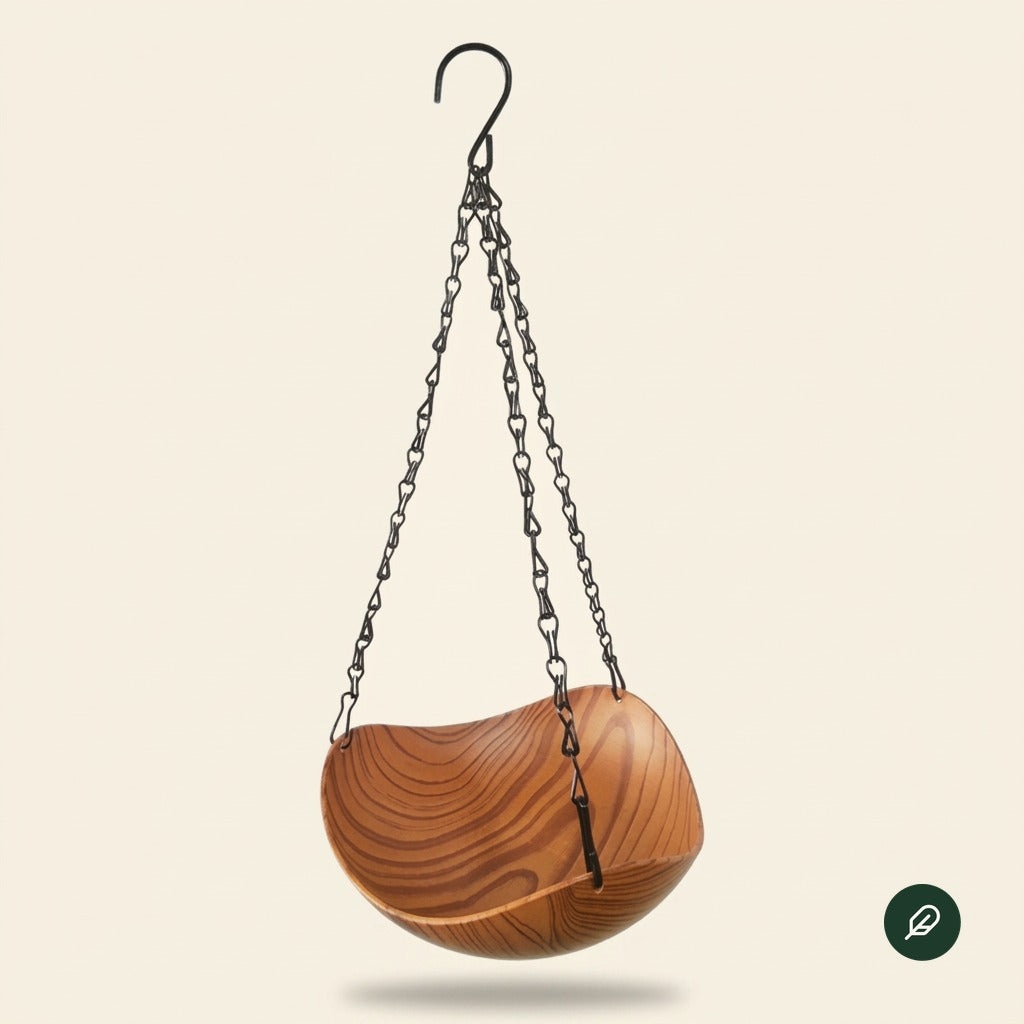
Hanging Basin Feeder and Water Bowl
A single open basin that hangs from a hook and does two jobs: a seed tray through the growing season, a shallow water bowl the rest of the year. Seed or water goes straight in — no reservoir, no perches, nothing to assemble beyond the hanging chains.Three chains run from the rim to one S-hook, so the basin hangs level under a bracket, a shepherd's hook or a low branch. Put it where you can watch it from a window, and where a cat can't launch from a fence.The rim is low and the floor is open, so birds can land anywhere around the edge instead of fighting over a perch. It also means the bowl needs wiping out every few days: hulls and droppings land in the water, and a rinse with hot water and a brush keeps it clean.The basin has a wood-grain finish and hangs from black metal chains.
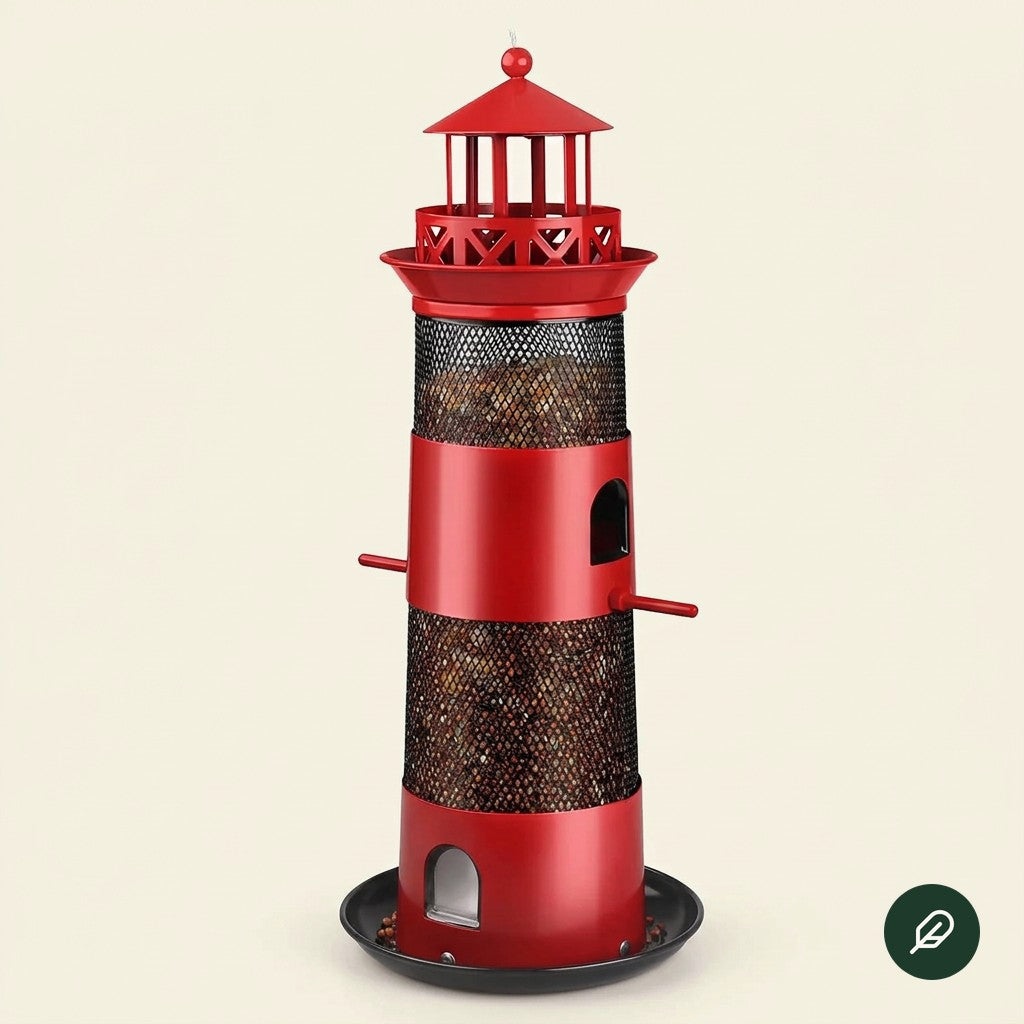
Lighthouse Metal Seed Feeder
A red-and-black metal seed feeder built in the shape of a lighthouse. The tall mesh body holds up to 4 lb of seed, with four feeding openings and perches arranged around the body. A circular tray catches some loose seed, and the top wire loop is used for hanging. Check and clean the feeder regularly, especially after wet weather.
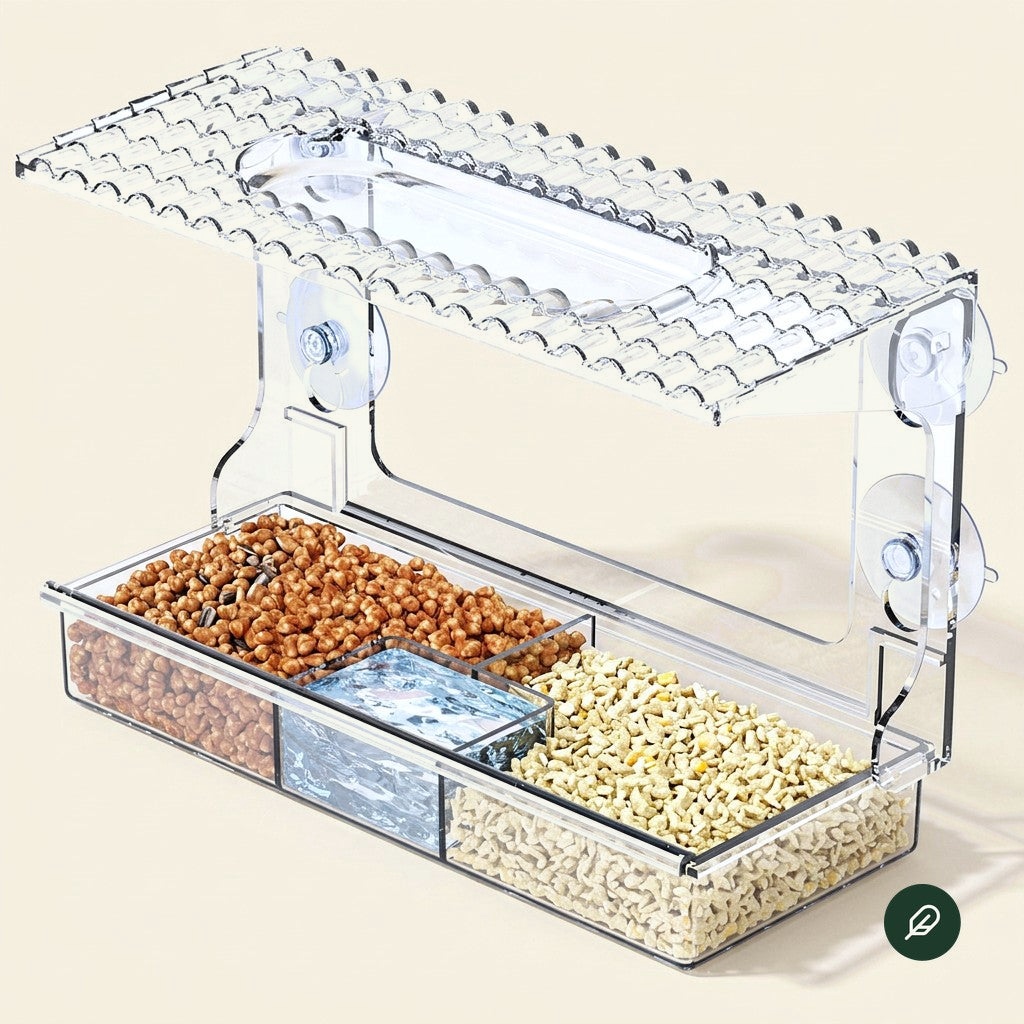
Window Feeder with Roof Bath
A wide clear acrylic window feeder with a textured roof that holds a shallow pool of water for small birds, plus a lift-out tray split into seed and water sections.Specs Clear acrylic, 4 suction cups Removable tray with drainage holes Roof basin catches rain; top it up in dry spells Tips Small birds only; jays and larger birds will crowd it. Pull the tray and rinse it weekly so wet seed doesn't mold.
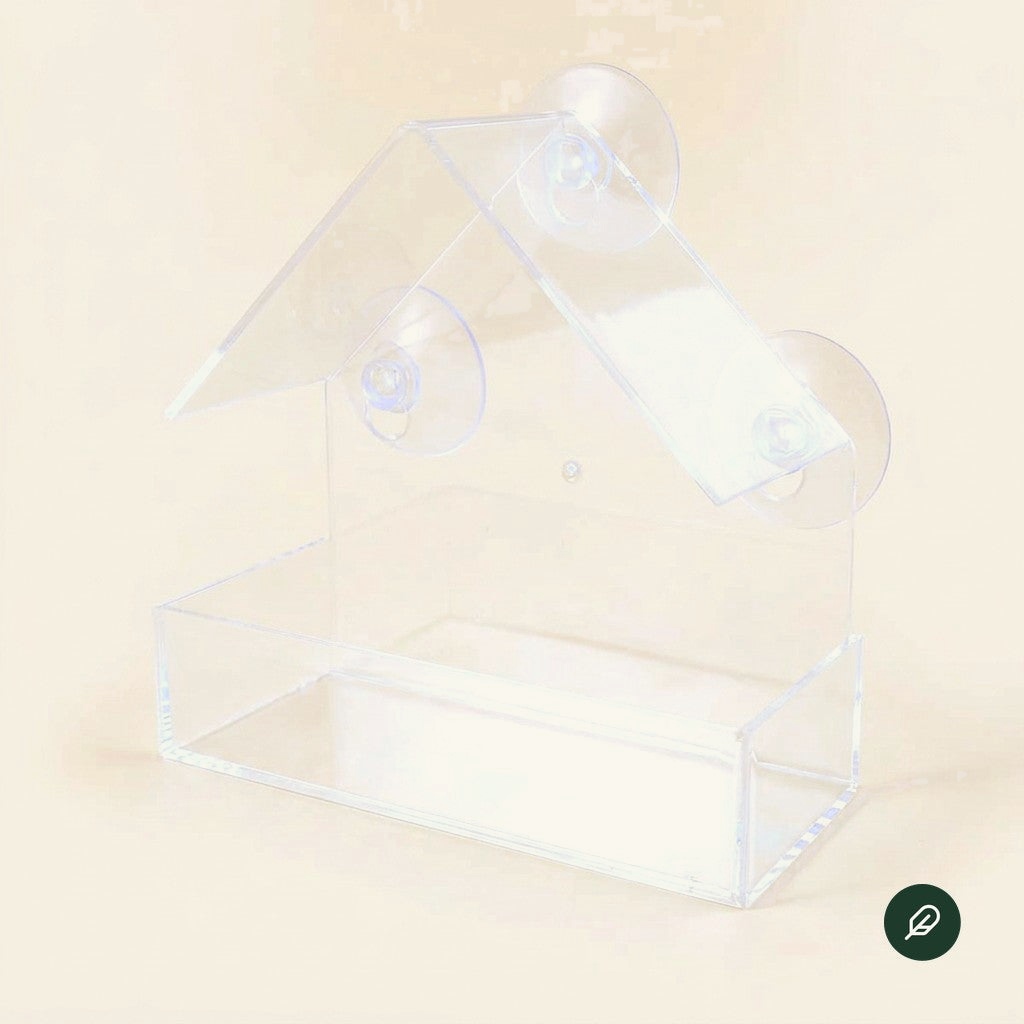
Clear Acrylic Window Feeder
Three clear acrylic window feeders that mount with suction cups. Pick the size that fits your window. Small House — peaked roof, open tray, about 15 x 15 x 7 cm. Arched Roof — about 25 x 19 x 9.5 cm, green perch bar, two-section drain tray. Slanted Roof — about 21 x 20.5 x 14.5 cm, black perch bar, two-section drain tray. TipsClean the glass before mounting. Suction cups hold best above freezing.

- Root cause
- Spilled seed and hulls under feeders — not the feeder itself
- Colony math
- One rat needs ~1 oz of food/day; a month of spill supports a colony
- Best feeder types
- Catch-tray tubes, no-scatter designs, feeder trays with mesh floors
- Seed that helps
- Shell-on seeds (sunflower) spill hulls; hulled mixes spill far less
- Never
- Poison where birds of prey feed — use exclusion, not toxins
Why the rats are really there
Rats are nearly blind to birds and uninterested in climbing to a tube feeder — what draws them is the floor of your feeding station. Every feeder spills: birds sort through mixes and fling out a third of the contents, hulls pile up, and a single cup of sunflower scattered on the ground per day is a rat's entire food requirement with surplus. Feeding birds without managing spillage is, in a suburban yard, slowly running a rat restaurant. The colony shows up within weeks and stays as long as the floor keeps paying.
Mice and voles are similar but less dramatic; rats are the ones that trigger health complaints and neighbor disputes. The good news is that rat colonies are entirely food-driven. Remove the ground food consistently for a few weeks and the rats leave — poison and traps become almost unnecessary in a yard that actually feeds birds cleanly. The sequence below is ordered; skipping step one makes the rest cosmetic.
Step 1: cut the spill at the source
Feeder choice is spill control. Tube feeders with catch trays at the base stop seed from ever reaching the ground; feeder trays with mesh floors let hulls fall through while holding seed, drying it instead of letting it rot. Avoid open platform feeding of cheap mixes — that's maximum spill. Port size matters too: ports sized to the seed (small for nyjer, proper for sunflower) reduce the flinging that comes from birds digging for a seed worth taking.
The feed itself is the other half. Cheap mixes are mostly filler (milo, millet, corn) that songbirds throw overboard looking for the good stuff — the spill rate of a budget mix can exceed half its weight. Feeding single-seed rations (straight black-oil sunflower, straight safflower, straight nyjer) means birds eat what you offer instead of sorting it, and hull-based seed like sunflower at least leaves only hulls, which rats can't sustain a colony on. Hulled sunflower chips spill nothing but waste, at higher cost per pound — the right trade in tight yards.
- Tube feeders with catch trays or mesh-floor trays catch spill before it lands.
- Feed single-seed rations, not filler mixes — birds stop flinging.
- Hulled sunflower chips = near-zero mess where rats are already established.
- Feed only what your birds finish in 1–2 days; a half-empty feeder is spill waiting to happen.
Step 2: clean the floor under the station
Established spill and hull buildup feeds rats indefinitely — an accumulation under a long-running feeder can hold thousands of seeds. Rake or vacuum the area under the feeders weekly (hulls are also a disease reservoir, so this doubles as disease control). Wet the hulls down before raking in dry climates to keep dust down. If the feeding station sits over mulch or gravel, rake deep and turn the material; if it sits on a deck, sweep daily during an active rat problem.
While you're at it, look at the rest of the night menu: pet food bowls left out, trash with loose lids, fallen fruit from a tree, compost with scraps, bird seed stored in a shed in bags a rat can chew. A feeding-station fix survives only if the yard's total food supply drops. Rats patrol a few hundred feet at most; your yard is the whole world to them, and every food source you close pushes the colony's math toward moving.
Step 3: change the feeding schedule and station
Rats are nocturnal; songbirds aren't. If rats have moved in, feed only during morning hours, and take feeders in at dusk — this alone starves a rat colony that's been feeding at night. After two or three clean weeks, you can return to all-day feeding with the spill controls in place. Move the feeding station, too: rats follow routes and remember locations, and relocating the pole fifteen feet (onto a defended, baffled pole over raked ground) breaks their map while your birds re-find it in a day.
Where the station sits matters permanently. Hard surfaces (paving, packed gravel, short mown grass) are easier to keep clean than mulch beds and shrub borders, which give rats cover. A station in open lawn with a raked perimeter is a poor rat habitat and a good bird station. If you also feed corn or peanuts on the ground for doves and jays, stop during a rat problem — ground-feeding is rat catering.
What about traps and poison?
For a yard that feeds birds, poison is the worst option. Rodenticides don't kill instantly; a poisoned rat staggers into the open and becomes food for Cooper's hawks, owls, cats and foxes — secondary poisoning is well-documented in raptors and is why several rodenticides are now restricted. Snap traps in tamper-resistant bait stations placed along fence lines (not in the open feeding zone) are the standard non-toxic approach if you must intervene, set only at night and cleared before dawn so birds and pets stay safe.
But in most yards, exclusion works without any of this. The rats are there because the floor pays out; cut the spill, clean it up, and feed on the birds' schedule, and the colony relocates within two to four weeks. It's slower than poison and permanent in a way poison isn't — poison creates a vacuum that a new colony fills the following season unless the food source is gone.
Frequently asked
Why do I have rats under my bird feeder?
Spilled seed and hulls on the ground. A single cup of scattered sunflower a day feeds a rat. Cut the spill with catch-tray feeders and clean the ground weekly.
Will rats climb bird feeders?
Rarely — they take the easy calories on the ground. Stop the spill and the feeder itself is mostly safe.
Is rat poison safe around birds?
No. Poisoned rats get eaten by hawks, owls and pets, causing secondary poisoning. Use spill control and exclusion first; if trapping, use tamper-resistant stations set at night.
How long until rats leave after I stop the spill?
Typically two to four weeks of consistent cleanup and dusk-to-dawn feeder removal starves the colony out and they relocate.
More troubleshooting
- Why Birds Stopped Coming to Your Feeder (and What to Do by Season)
- Keeping House Sparrows Out of Bluebird and Chickadee Boxes
- A Hawk Is Hunting at My Bird Feeder: What It Means and What to Do
- Keep Squirrels Off a Shepherd's Hook and Out of Feeders
- How to Get Rid of Grackles at Your Feeders (Without Losing the Birds You Want)
- How to Keep Starlings Off Your Feeders (Suet, Seed and Nest-Box Problems)
- How to Stop Raccoons Raiding Your Bird Feeders (and Your Nest Boxes)
- Bears and Bird Feeders: When to Take Feeders Down (and How to Feed Birds in Bear Country)
- Bird Feeder Placement: Height, Distance and Sightlines That Actually Work
- How to Keep Cats Away From Your Bird Feeders (Yours and the Neighbors')
- Sick Birds at Your Feeder: House Finch Eye Disease, Salmonella and What To Do
- How to Keep Crows and Jays From Taking Over Your Feeders
- Why a Woodpecker Is Pecking Your House (and How to Make It Stop)
- Choosing and Placing a Bird Bath: Depth, Material, Moving Water and Location
- How to Clean a Bird Bath: Algae, Safe Cleaning and Mosquitoes
- Bird Bath Water Through the Seasons: Freezing Winters and Summer Heat
- Why Birds Won't Use Your Bird Bath: 8 Common Reasons and Fixes
- Window Bird Feeders in the UK: Which Birds Use Them and How to Make One Stick
- How to Set Up a Bird Feeding Station in a UK Garden
- Robin Bird Box: Open-Front Design, Height and Where to Put It
- Squirrel-Proof Bird Feeders in the UK: What Stops Grey Squirrels
- Bird Baths for UK Gardens: Depth, Placement and Keeping Ice Off
- Heated Bird Baths in Canada: Keeping Water Open at -20°C
- Winter Bird Feeding in Canada: Foods, Feeders and What Shows Up
- Squirrel-Proof Bird Feeders in Canada: Red, Grey and Black Squirrels
- Bird Feeders for Condos and Balconies in Canada
- How to Attract Chickadees in Canada: Food, Nest Boxes and Winter Care
- Caged Bird Feeders: Keep Out Squirrels, Starlings and Grackles
- Upside-Down Suet Feeders: Feed Woodpeckers, Not Starlings
- Window Bird Feeders: Which Ones Stay Up, and Which Birds Come
- Bird Feeder Pole Setup: Height, Depth and Baffle Placement
- Deck Railing Bird Feeders: Mounting, Mess and Squirrels