Squirrel-Proof Bird Feeders in the UK: What Stops Grey Squirrels
Grey squirrels are clever, persistent and widespread across Britain. Which feeders actually keep them out, how far they jump, and what to do if red squirrels visit your garden.
8 min read · Updated 2026-10-27
Equipment for this job
A caged tube feeder and a baffle — the two pieces that do most of the work. We deliver to the UK.
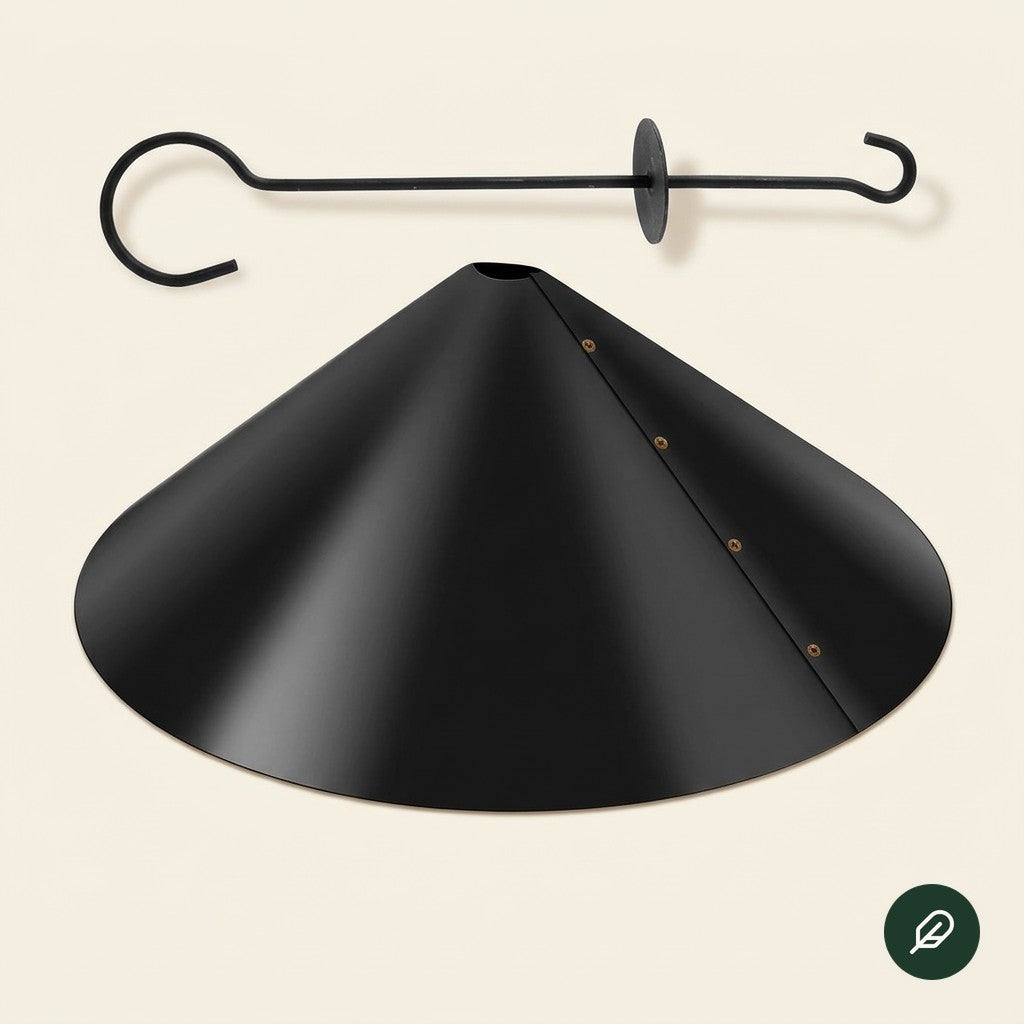
18-Inch Squirrel Baffle
A wide black baffle for helping keep squirrels from reaching a hanging or pole-mounted feeder. The cone measures 18 inches (45.7 cm) across. Choose the hanging-hook setup or pole-collar setup to suit your feeder station. Position the baffle so squirrels cannot bypass it from a nearby branch, railing, or roof.
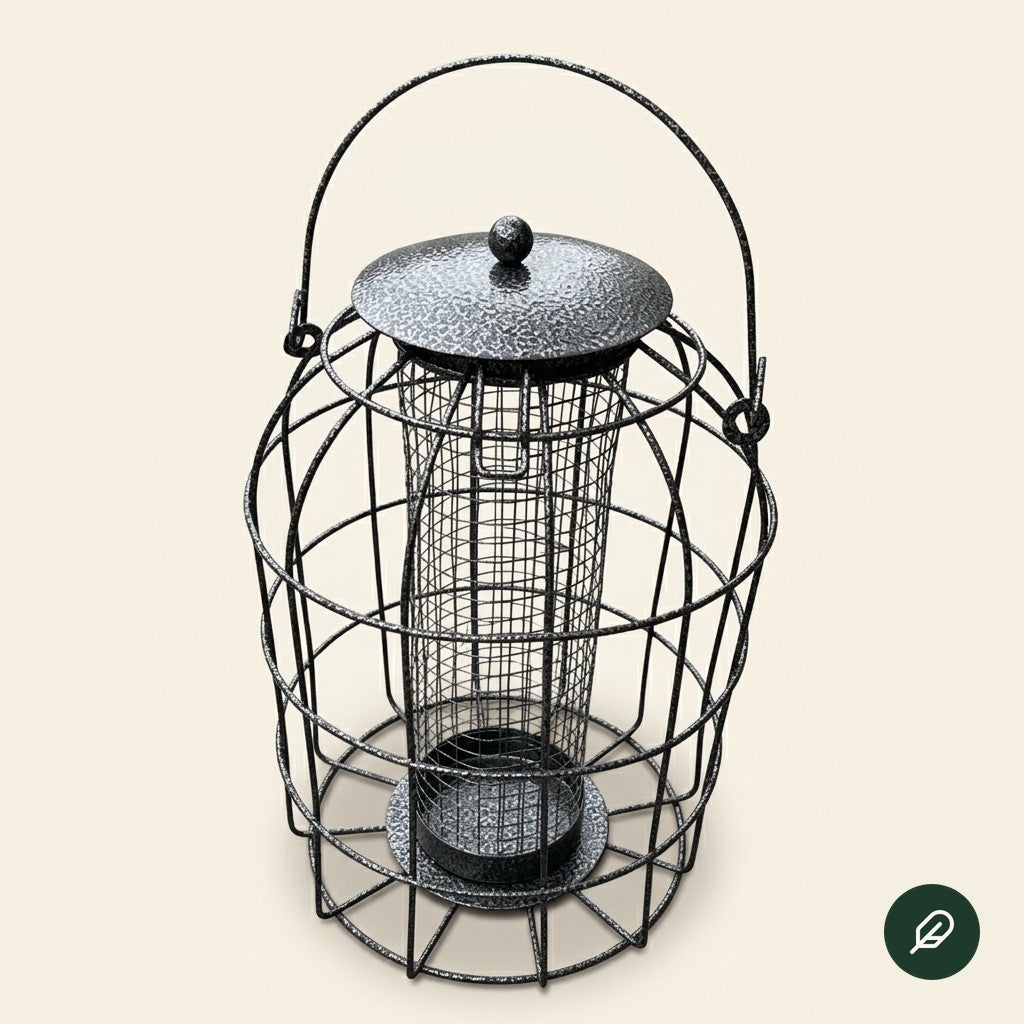
Caged Tube Bird Feeder
A metal tube feeder inside a wide protective cage. The outer cage limits access by squirrels and larger birds while smaller birds can reach the inner seed tube. A top handle makes it easy to hang, and the lid lifts for refilling. Available in black or green. No feeder is completely squirrel-proof, so placement still matters.

- Vertical jump
- About 1.5 m
- Sideways leap
- Up to about 3 m
- Cage gap
- Around 3–3.5 cm lets small birds in, keeps greys out
- Baffle height
- Bottom edge at least 1.2 m off the ground
- Legal note
- Trapped grey squirrels may not legally be released
Why grey squirrels win most of the time
The grey squirrel arrived from North America in the late 1800s and is now found across most of England, Wales and lowland Scotland, and in much of Ireland. It is bigger and bolder than the native red, and a garden feeder is an easy source of high-fat food. One squirrel can empty a peanut feeder in an afternoon and chew through plastic ports to get at sunflower hearts.
No single trick stops them for good. What works is a combination: feeders they physically can't get into, placed where they can't reach, with nothing on the ground to reward them. Miss one of those and they'll find the gap.
Three things that actually work
Most squirrel-proofing falls into three categories. Use at least two.
- A cage: an outer steel guard around a tube feeder, with gaps of roughly 3 to 3.5 cm. Tits, finches, sparrows and Robins get through; grey squirrels and Woodpigeons don't. The cage needs to be far enough from the inner tube that a squirrel can't reach in with its paws.
- A baffle: a wide dome above a hanging feeder, or a cone or tube on a pole with its bottom edge at least 1.2 m off the ground. Squirrels can't climb or reach round it.
- Distance: keep the feeder at least 3 m from fences, walls, sheds and branches. Greys jump about 1.5 m straight up and leap around 3 m sideways.
What doesn't work
Plastic feeders without metal ports get chewed. Thin wire hangers let squirrels slide down from a branch. Grease on poles is cruel and messes up birds' feathers, and it's not recommended by any UK wildlife charity. Chilli-treated seed is sold as a squirrel deterrent; birds can't taste capsaicin, so it doesn't harm them, but squirrels often learn to tolerate it and the dust is unpleasant to handle.
Feeding the squirrels somewhere else works in some gardens and backfires in others. A separate squirrel feeder far from the bird station can keep them busy, but it also feeds more squirrels.
If red squirrels visit
Red squirrels are protected and in decline, surviving mainly in Scotland, Northumberland and Cumbria, Anglesey, parts of Northern Ireland and a few island populations. If reds come to your garden, you're lucky. Many local red squirrel groups encourage feeding them with hazelnuts in a dedicated box feeder — and ask you to report sightings of greys, because greys carry squirrelpox, which is fatal to reds.
Hygiene matters even more in red squirrel areas: clean feeders regularly so disease isn't spread between animals using the same food.
The law on grey squirrels
Grey squirrels are listed as an invasive non-native species. Under the Wildlife and Countryside Act 1981 and the Invasive Alien Species (Enforcement and Permitting) Order 2019, it is illegal to release a grey squirrel you have trapped, or to let one go elsewhere. Anyone considering control should read the official guidance first. For most gardens, excluding them from feeders is simpler and causes no welfare problems.
Setting up a squirrel-resistant station
Put a caged tube of sunflower hearts on a pole or arm with a baffle underneath, 3 m from anything a squirrel can jump from. Hang a suet cage under a wide dome. Sweep up spilt seed under the station every few days, or use husk-free food so there is less spillage. Squirrels that get nothing usually move on to easier gardens within a week or two.
Check the station after you set it up. Watch for a day: where does the squirrel try first? It will show you the weak point, usually a branch you didn't notice or a fence post closer than you thought.
Food choices that help
What you put out changes how hard squirrels try. Sunflower hearts and nyjer in a caged feeder are less rewarding to a squirrel than a mesh feeder full of peanuts, which is the single most squirrel-attracting thing you can hang in a British garden. If you want to offer peanuts, keep them inside a cage or under a baffle, and accept that they will be the first target.
Suet blocks and fat balls are another favourite. Hang them under a wide dome and well away from fences. A squirrel that has to work for an hour for a few crumbs will usually give up and go next door, where the feeders are easier. Consistency matters: if you leave a weak spot one weekend, the squirrels learn the station is worth checking again.
Sources
Squirrel and feeding advice draws on RSPB guidance.
Frequently asked
What is the best squirrel-proof bird feeder in the UK?
A caged tube feeder with metal ports and gaps of roughly 3–3.5 cm, hung under a baffle and kept 3 m from fences and branches.
How far can grey squirrels jump?
About 1.5 m straight up and roughly 3 m sideways from a fence, wall or branch.
Does chilli seed stop squirrels?
Birds can't taste capsaicin so it won't harm them, but squirrels often get used to it. Physical barriers work better.
Can I release a grey squirrel I catch?
No. Grey squirrels are an invasive non-native species and releasing one is illegal in Great Britain.
More UK garden guides
- Window Bird Feeders in the UK: Which Birds Use Them and How to Make One Stick
A suction-cup feeder on the glass is the easiest way to feed birds from a flat, a terrace with no garden, or a kitchen window. What visits, what to put in it, and how to stop it sliding off in the cold.
- How to Set Up a Bird Feeding Station in a UK Garden
A good feeding station is about placement more than the pole. Where to put it, how high, what to hang on each arm, and how to keep it from feeding the local squirrels, pigeons and Sparrowhawk.
- Robin Bird Box: Open-Front Design, Height and Where to Put It
Robins won't use a box with a small round hole. They want an open-fronted box, low down and well hidden. The dimensions, the best spots in a British garden, and when to put it up.
- Bird Baths for UK Gardens: Depth, Placement and Keeping Ice Off
A bird bath is often more useful than another feeder. How deep it should be, where to put it, how often to clean it, and how to keep water open on a frosty British morning without chemicals.
More troubleshooting
- Why Birds Stopped Coming to Your Feeder (and What to Do by Season)
- Keeping House Sparrows Out of Bluebird and Chickadee Boxes
- A Hawk Is Hunting at My Bird Feeder: What It Means and What to Do
- Keep Squirrels Off a Shepherd's Hook and Out of Feeders
- How to Get Rid of Grackles at Your Feeders (Without Losing the Birds You Want)
- How to Keep Starlings Off Your Feeders (Suet, Seed and Nest-Box Problems)
- How to Stop Raccoons Raiding Your Bird Feeders (and Your Nest Boxes)
- Bears and Bird Feeders: When to Take Feeders Down (and How to Feed Birds in Bear Country)
- How to Stop Rats and Mice Moving In Under Your Bird Feeders
- Bird Feeder Placement: Height, Distance and Sightlines That Actually Work
- How to Keep Cats Away From Your Bird Feeders (Yours and the Neighbors')
- Sick Birds at Your Feeder: House Finch Eye Disease, Salmonella and What To Do
- How to Keep Crows and Jays From Taking Over Your Feeders
- Why a Woodpecker Is Pecking Your House (and How to Make It Stop)
- Choosing and Placing a Bird Bath: Depth, Material, Moving Water and Location
- How to Clean a Bird Bath: Algae, Safe Cleaning and Mosquitoes
- Bird Bath Water Through the Seasons: Freezing Winters and Summer Heat
- Why Birds Won't Use Your Bird Bath: 8 Common Reasons and Fixes
- Heated Bird Baths in Canada: Keeping Water Open at -20°C
- Winter Bird Feeding in Canada: Foods, Feeders and What Shows Up
- Squirrel-Proof Bird Feeders in Canada: Red, Grey and Black Squirrels
- Bird Feeders for Condos and Balconies in Canada
- How to Attract Chickadees in Canada: Food, Nest Boxes and Winter Care
- Caged Bird Feeders: Keep Out Squirrels, Starlings and Grackles
- Upside-Down Suet Feeders: Feed Woodpeckers, Not Starlings
- Window Bird Feeders: Which Ones Stay Up, and Which Birds Come
- Bird Feeder Pole Setup: Height, Depth and Baffle Placement
- Deck Railing Bird Feeders: Mounting, Mess and Squirrels